
Buying oxygen equipment: the source sets the limit
A concentrator's output, a high-flow system's gas flow and a ventilator's support modes are different capabilities. Match them before spending.
Sources reviewed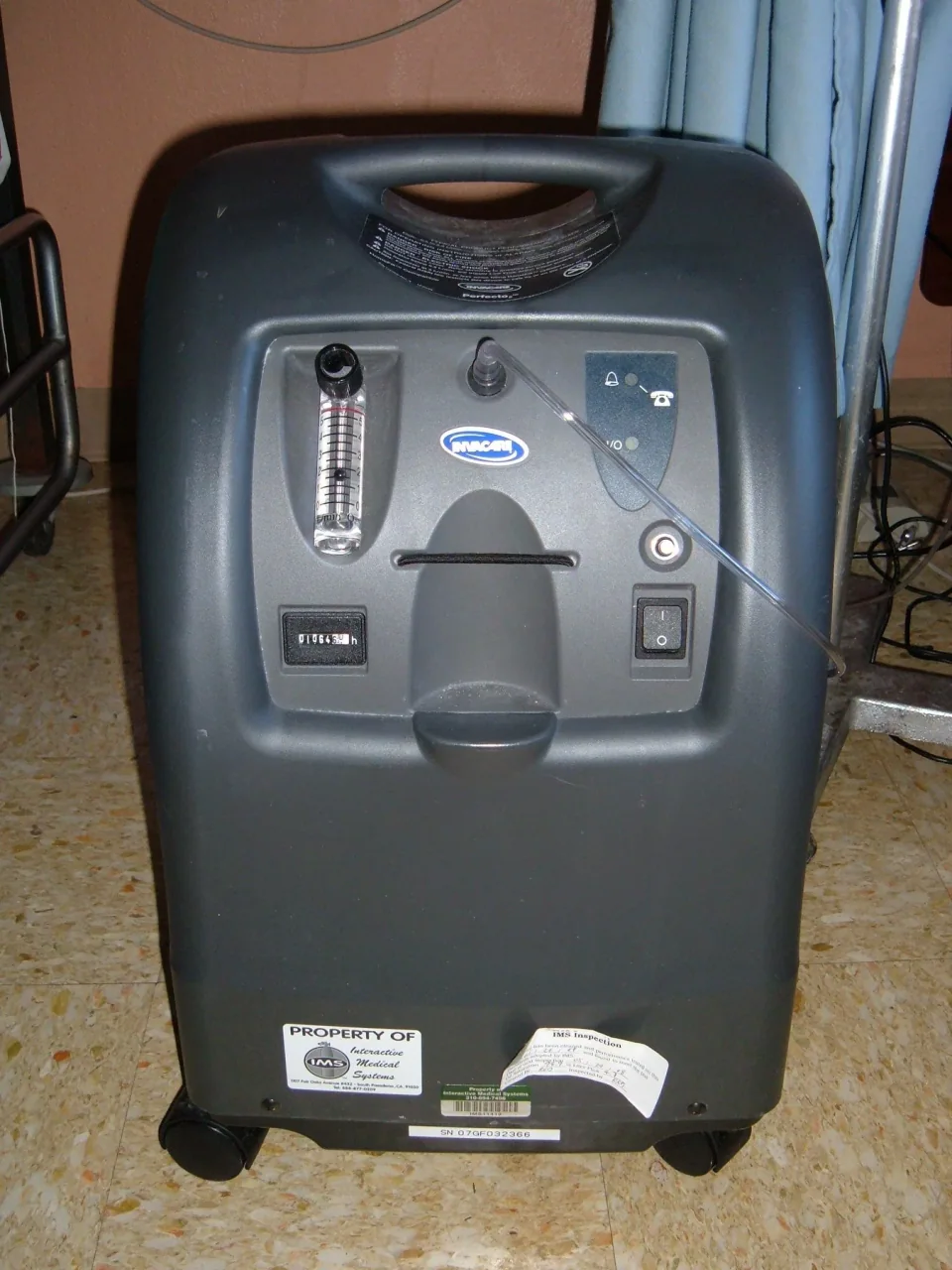
About this photograph
Actual Invacare Perfecto 2; not represented as a Drive DeVilbiss 1025 or an AirSep unit.
The decision at a glance.
- Start here
- Where 1–5 L/min meets the requirement, compare VisionAire 5 with the oxygen-monitor option. For requirements up to 10 L/min, compare the correct DeVilbiss 1025 and NewLife Intensity 10 electrical variants.
- Consider alternatives when
- Price Airvo 2, Airvo 3 and HVT 2.0 as complete high-flow stations. For acute NIV, compare configured C1 or Savina. AirCurve ST-A, Astral and sleep CPAP require their own intended-use comparisons.
- Watch the budget
- High-flow devices do not generate oxygen. Include source capacity, backup, chambers, tubing and interfaces. VisionAire's published 290 W and Intensity 10's 600 W make electricity a meaningful operating-cost input.
- Check the support
- Confirm approved source/device compatibility, concentration at required flow and repair access. Keep Airvo 2 and Airvo 3 correction records distinct; one does not resolve the other.
Ask the supplier
- What oxygen flow and pressure must our source deliver simultaneously?
- Which voltage, oxygen monitoring and backup arrangements are included?
- What is the annual complete consumable basket for this respiratory station?
Buy enough oxygen, without paying for unused capacity
The first comparison is the demand the facility must meet at the same time. A concentrator, cylinder supply and an engineered PSA plant put different burdens on electricity, maintenance and delivery. WHO's facility-system specifications treat source, storage and distribution together. That is why a plant brand cannot be selected usefully from this equipment list alone: the site and its demand determine the installation.
For a small service, VisionAire 5 is worth considering when its 1–5 L/min range fully covers the requirement. Its published draw is 290 W, while NewLife Intensity 10 publishes 600 W. Those figures make power use a real budget variable; they do not make the smaller unit a substitute for missing capacity. For a requirement up to 10 L/min, 1025 and Intensity 10 provide an identifiable comparison, including oxygen monitoring, regional electrical variant and the repair route.
The opened 1025DS-bundle offer gives a concrete USD 1,399.00 starting point on October 16, 2026, with the contents and exclusions recorded in the model card. It does not price a hospital oxygen network. Add backup and any approved connection to the downstream equipment. The earlier suggestion to join concentrators in series is not carried forward: obtain a manufacturer-approved supply design instead of making a connection that the purchase evidence does not support.
Compare complete high-flow stations before their prices
Airvo 2 needs a configured offer before it can serve as a budget comparison. The opened ILAP Biomed page identifies a new Airvo 2 but leaves the electrical variant, included kit, stock and warranty scope unclear; retain it only as an unconfigured seller lead. Price the required stand, oxygen connection, chambers, heated tubing, interfaces and reprocessing resources with the identified unit. Then compare annual disposable and oxygen costs alongside the complete capital bill.
Airvo 3 has an identifiable capability case: its cleared submission describes interface-dependent 2–70 L/min operation and both high- and low-pressure oxygen inputs. HVT 2.0 offers a different integrated-blower and disposable system, with 5–45 L/min in the cited IFU for patients at least 5 kg. The right comparison is the intended population, station workflow and supply chain. Neither a higher flow ceiling nor a lower purchase price proves that one service will work better. The cited labeling excludes field transport and total ventilatory support for both newer platforms.
Correction status is part of completing the offer. Airvo 2's reviewed action updates disinfection-kit instructions, including an audible power-out alarm check. Airvo 3's reviewed action concerns specified older PT301US software and high-pressure-oxygen behavior. Keep those records separate: one model's documented correction does not settle the other's.
A legacy Philips bargain has a support clock
Philips' portfolio table puts dates on part of the ownership calculation: EverFlo and Millennium M10 have January 2024 sales/shipment milestones and January 2029 service milestones; V60/V60 Plus has an August 2022 sales endpoint and December 2029 service milestone. Region and part number qualify the table, and parts remain subject to availability. An existing serviced machine may still earn its place. Importing another is a new commitment, so use the applicable remaining support period rather than the original purchase price to judge it.
BiPAP Vision is a legacy keep-only candidate until exact support and parts can be demonstrated; this review did not establish a current manufacturer pathway. DreamStation is not a generic recommendation: determine the precise BiPAP model, applicable foam-recall history and remediation. A separate 2025 DreamStation recall involved programming errors in certain devices. V60's documented power-circuit/alarm action is a different recall issue, not the DreamStation foam issue.
For a new purchase, keep the jobs distinct. Acute hospital NIV brings C1 or a configured Savina 300 into consideration. AirCurve 10 ST-A has respiratory-insufficiency indications and modes/alarms beyond basic sleep CPAP; Astral is a portable ventilation platform, with a double-limb circuit option on Astral 150. AirSense 11 AutoSet and AirMini belong to sleep therapy, with AirMini's dedicated travel accessories part of its cost. An inexpensive donation should meet the service specification rather than silently rewrite it.
Budget for the interruption most likely to stop the service
A healthy concentrator still needs electricity. A working high-flow console still needs oxygen, water and compatible disposable supplies. A serviceable legacy unit still needs parts within its remaining support horizon. Count those interruptions alongside hardware repairs when comparing availability. This review found current manuals, lifecycle notices and specific corrective actions, but no comparable field failure rates. Use the evidence to price a complete service, not to label one brand the most durable.
Compare the options.
DeVilbiss 1025 / NewLife Intensity 10
- Capability
- Stationary concentrators reaching 10 L/min with published 20 psi-class outlets
- Best fit
- A defined oxygen requirement that exceeds 5 L/min
- Cost to watch
- Electrical variant, power use, oxygen monitoring, maintenance and backup
VisionAire 5, oxygen-monitor version
- Capability
- 1–5 L/min; published 290 W draw
- Best fit
- A requirement fully met by the lower output
- Cost to watch
- Correct monitoring/electrical variant and support
Airvo 2
- Capability
- Flow generator and humidifier; requires a separate oxygen source
- Best fit
- A complete mains-powered high-flow station with available supplies
- Cost to watch
- Heated tubing, chambers, interfaces, reprocessing and source capacity
Airvo 3 / Vapotherm HVT 2.0
- Capability
- Airvo 3: interface-dependent 2–70 L/min; HVT 2.0: 5–45 L/min in the cited IFU
- Best fit
- A service whose population and workflow fit the exact labeling
- Cost to watch
- Oxygen inputs, configured accessories and proprietary disposables
HAMILTON-C1 / Savina 300 with NIV
- Capability
- Turbine ventilator platforms with specified acute NIV configurations
- Best fit
- Acute hospital ventilation requirements
- Cost to watch
- Enabled modes, patient range, sensors, batteries and humidification
AirCurve 10 ST-A / Astral 100–150
- Capability
- Defined bilevel support versus portable invasive/non-invasive ventilation
- Best fit
- The specific prescribed support role; not interchangeable sleep CPAP
- Cost to watch
- Labeled configuration, approved circuits, masks and backup power
Model notes, pricing & support 10 options
Drive DeVilbiss 1025 series, voltage variant specified
Identifiable 10 L concentrator
- Best for
- A continuous-flow requirement within the approved output and environment
- Why consider it
- The current 1025 offering specifies 2–10 L/min and a 20 psi outlet. It retains the original review's emphasis on a recognizable serviceable platform without assuming every older unit has the same condition.
- The trade-off
- Electrical variant, oxygen concentration at rated flow and repair access matter more than nominal maximum output. A concentrator is not automatically a suitable source for every downstream device.
- Price & package
- The CPAP Shop displayed USD 1,399.00 for its 1025DS-bundle on October 16, 2026. Box contents include the concentrator, AC cord, installed filters, adapter, manual and five cannulas; an optional intake bacteria filter is USD 33.99. Verify electrical variant and export warranty; tax, overseas freight and import costs are not included in this budget anchor.
- Support
- Current Drive product and support program found. Program eligibility and exported-unit service require confirmation.
CAIRE AirSep NewLife Intensity 10
Alternative 10 L supply
- Best for
- A facility comparing another identifiable high-flow stationary platform
- Why consider it
- Published output up to 10 L/min and 20 psig makes it a meaningful specification comparison with 1025 rather than a smaller machine sold as equivalent.
- The trade-off
- Published 600 W power demand and substantial weight belong in the electrical and shipping budget. Outlet pressure alone does not establish approved compatibility with a ventilator.
- Price & package
- Quote required; include correct regional variant and preventive-maintenance supplies.
- Support
- Manufacturer publishes current product literature and manual; destination technician and component availability unconfirmed.
CAIRE AirSep VisionAire 5 with oxygen-monitor option
Lower-capacity oxygen supply
- Best for
- A defined requirement within 1–5 L/min
- Why consider it
- Its published 290 W draw makes it worth comparing when a 10 L unit's extra capacity is unnecessary. Specify the oxygen-monitor-equipped version rather than assuming it is standard.
- The trade-off
- The smaller output cannot be treated as spare capacity for high-demand systems. Manufacturer marketing about low failure rates supplies no comparative field data.
- Price & package
- Quote required for the oxygen-monitor version and correct electrical configuration.
- Support
- Current product documentation found; warranty geography and repair pathway need confirmation.
Fisher & Paykel Airvo 2
Established high-flow platform
- Best for
- A service with compatible supplies and a defined mains-powered high-flow station
- Why consider it
- The established flow-generator/humidifier platform has an identifiable tube, chamber and interface ecosystem. Its older generation can be reasonable value when the complete package and correction status are satisfactory.
- The trade-off
- It is not an oxygen generator. Oxygen capacity, power continuity, reprocessing resources and single-patient consumables are separate costs.
- Price & package
- Quote required for the exact electrical variant, included accessories and warranty. The ILAP Biomed listing is an explicitly unconfigured seller lead; its asking amount is not a complete-system budget or a like-for-like comparison price.
- Support
- MSF lists the platform and accessories; FDA records a 2025 disinfection-manual/alarm-check correction. Obtain serial-specific service and corrective-action evidence.
Fisher & Paykel Airvo 3
Newer high-flow capabilities
- Best for
- A service that benefits from the newer interface and oxygen-input configuration
- Why consider it
- The FDA-cleared submission documents 2–70 L/min, interface-dependent, plus high- and low-pressure oxygen inputs. Those are concrete reasons to price the newer system.
- The trade-off
- More capability does not eliminate oxygen supply limits. The cleared device is not intended to provide total ventilatory requirements or field transport.
- Price & package
- Quote required for current regional configuration, accessories and applicable battery options.
- Support
- Regulatory documentation verified; 2024 software correction affects specified PT301US versions. Current corrected software and local service must be confirmed.
Vapotherm HVT 2.0
Alternative high-flow supply system
- Best for
- A program deliberately choosing Vapotherm interfaces and disposable supply
- Why consider it
- The current IFU describes an integrated blower and 5–45 L/min delivery for its specified population. It can be compared as a complete service rather than on maximum flow alone.
- The trade-off
- The cited IFU covers patients at least 5 kg and excludes field transport and total ventilatory support. Proprietary disposables and local stock can outweigh a capital discount.
- Price & package
- Quote required including patient circuits, cannulas, oxygen connection and transfer accessories.
- Support
- Current manufacturer IFU verified; destination service and annual disposable expenditure unconfirmed.
HAMILTON-C1 / Dräger Savina 300 NIV configuration
Acute hospital NIV
- Best for
- A hospital requiring a ventilator platform with specified acute-care monitoring and alarms
- Why consider it
- Both have documented turbine-based ventilation platforms and NIV capability. Their broader ventilation role can justify cost when the service genuinely needs that capability.
- The trade-off
- The exact patient range, enabled modes, oxygen inlet, battery and humidification package must match the clinical specification. Do not assume a basic Savina 300 includes every NIV/high-flow option.
- Price & package
- Separate complete quotes required; see ventilator comparison for configuration tradeoffs.
- Support
- Current manufacturer offerings verified, with local support and serial-specific configuration still open.
ResMed AirCurve 10 ST-A
Prescribed bilevel-support role
- Best for
- A prescribed home or hospital NIV requirement within this model's labeling
- Why consider it
- ST-A has respiratory-insufficiency indications and modes/alarms beyond generic sleep CPAP. The exact suffix matters: an AirCurve family label alone does not identify this functionality.
- The trade-off
- Its labeled patient and mode limits and oxygen-connection requirements must be checked. It is not automatically an equivalent replacement for a V60 or a critical-care ventilator.
- Price & package
- Quote required including approved circuit, mask, humidification and any backup-power arrangement.
- Support
- Current product and user guide verified; authorized service access at destination unconfirmed.
ResMed Astral 100 / 150
Portable ventilation role
- Best for
- A defined portable invasive or non-invasive ventilation requirement
- Why consider it
- Astral is a ventilation platform rather than simply travel CPAP. Astral 150 adds capabilities including a double-limb circuit option, which may decide the comparison.
- The trade-off
- Higher capability brings circuit, sensor, battery and maintenance costs. It should be specified against its intended use, not purchased as a blanket acute-NIV substitute.
- Price & package
- Quote required for exact model, circuit type and accessories.
- Support
- Current manufacturer product/support documentation verified; local repair acceptance unconfirmed.
ResMed AirSense 11 AutoSet / AirMini
Sleep therapy and travel
- Best for
- A prescribed CPAP/APAP service, with AirMini reserved for a travel requirement
- Why consider it
- AirSense 11 is the fuller everyday sleep-therapy platform; AirMini's compactness can justify its dedicated travel ecosystem. This keeps the old AirMini recommendation in its appropriate category.
- The trade-off
- These are not bilevel or acute NIV substitutes. Compact size may mean different mask/tubing and humidification arrangements that reduce interchangeability with an existing fleet.
- Price & package
- Quote required for exact machine and compatible mask/accessory bundle.
- Support
- Current ResMed product pages verified; regional accessory supply and warranty remain quote questions.
Budget for the complete service.
Cost per available oxygen-supported service-hour = delivered equipment + electrical/backup infrastructure + oxygen generation or cylinder delivery + compatible disposables + water/reprocessing supplies + preventive service and repairs + downtime provision, divided by usable service-hours.
- Electricity, power conditioning, backup oxygen and source maintenance
- High-flow tubing, chambers, cannulas, water supply and reprocessing equipment
- Required oxygen flow and pressure at simultaneous demand
- PAP mask/circuit compatibility and batteries
- Remaining support horizon for a used Philips unit
Further checks & evidence limits
Questions to resolve
- What simultaneous oxygen flow and pressure must the facility supply, including backup?
- Which voltage and oxygen-monitor variants are being quoted?
- What precisely is included in the Airvo 2 offer, and what corrective actions are documented?
- Which software and serials apply to any Airvo 3 or legacy Philips unit?
- Is the required job acute NIV, portable ventilation, prescribed bilevel support or sleep CPAP?
What the evidence does not establish
- No independent comparative failure-rate evidence or equivalent delivered quotes were found.
- BiPAP Vision support and the historical Vapotherm model identity remain unresolved.
- Airvo manufacturer web/manual downloads were blocked; Airvo specifications were cross-checked using opened FDA submissions and MSF procurement documentation.
- Plant/cylinder vendor selection requires site demand, destination and delivery economics.
- Published Philips milestones have geographic/part-number qualifications and are not universal service guarantees.
Sources & supporting evidence.
Manufacturer claims and seller offers are identified below. Prices apply to the stated offer and review date; confirm availability, configuration and delivered cost.
- Drive 1025DS concentratorDrive DeVilbiss · manufacturer · checked October 16, 2026
Current 10 L platform, flow range and outlet pressure.
- Drive Advantage support programDrive DeVilbiss · manufacturer · checked October 16, 2026
Published support program with purchase eligibility conditions.
- NewLife Intensity 10CAIRE · manufacturer · checked October 16, 2026
10 L/min, outlet pressure, power and product literature.
- NewLife user manualCAIRE · manufacturer · checked October 16, 2026
Operating, oxygen-source and maintenance limitations.
- VisionAire 5CAIRE · manufacturer · checked October 16, 2026
1–5 L/min, 290 W and oxygen-monitor variant distinction.
- MSF Airvo 2 procurement entryMédecins Sans Frontières · institutional procurement · checked October 16, 2026
Airvo 2 specifications and separately listed accessories; not a public sales offer.
- Unconfigured new Airvo 2 seller leadILAP Biomed · seller listing · checked October 16, 2026
Opened body displays a $3,305 asking amount for an item labeled new Airvo 2. Electrical variant, kit, stock and warranty scope unresolved; retain only as an unconfigured seller lead, not a configured budget or comparison price.
- Airvo 2/myAirvo 2 correctionFDA · regulator · checked October 16, 2026
2025 disinfection-manual update includes audible alarm check; specifies expected service life.
- Airvo 3 510(k) submission K221338FDA / Fisher & Paykel Healthcare · regulator / manufacturer · checked October 16, 2026
Interface-dependent 2–70 L/min, oxygen inputs and intended-use limitations.
- Airvo 3 software correctionFDA · regulator · checked October 16, 2026
2024 action on specified PT301US software versions and high-pressure oxygen behavior.
- HVT 2.0 instructions for useVapotherm · manufacturer · checked October 16, 2026
Blower-based high flow, patient/flow limits, circuits and transport limitations.
- HAMILTON-C1Hamilton Medical · manufacturer · checked October 16, 2026
Turbine ventilator with NIV and configuration-dependent capabilities.
- Savina 300 NIVDräger · manufacturer · checked October 16, 2026
NIV platform and optional high-flow functionality.
- AirCurve 10 ST-AResMed · manufacturer · checked October 16, 2026
Identified respiratory-support bilevel variant.
- AirCurve 10 ST-A user guideResMed · manufacturer · checked October 16, 2026
Home/hospital indications, patient/mode limits, oxygen and accessory requirements.
- Astral 100/150ResMed · manufacturer · checked October 16, 2026
Portable invasive/NIV platform and model distinctions.
- AirSense 11ResMed · manufacturer · checked October 16, 2026
Sleep CPAP/APAP platform.
- AirMiniResMed · manufacturer · checked October 16, 2026
Travel CPAP system and accessory ecosystem.
- Philips respiratory portfolio updatePhilips · manufacturer · checked October 16, 2026
Published EverFlo/Millennium/V60 lifecycle milestones with regional and part-number qualifications.
- DreamStation programming-error recallFDA · regulator · checked October 16, 2026
2025 recall of certain DreamStation devices, distinct from foam recall.
- Philips V60 product correctionFDA / Philips · regulator / manufacturer · checked October 16, 2026
Power-circuit and alarm issue affecting specified V60/V60 Plus/V680 devices.
- Facility-based medical oxygen systems technical specificationsWorld Health Organization · institutional procurement · checked October 16, 2026
Facility oxygen-source, storage and distribution specification framework.
- Recalled Philips respiratory devicesFDA · regulator · checked October 16, 2026
Foam-recall information; exact device identity and remediation matter.
- The CPAP Shop 1025DS concentrator offer and suppliesThe CPAP Shop · seller listing · checked October 16, 2026
Opened page shows SKU 1025DS-bundle, $1,399.00 base unit, listed box contents and $33.99 optional intake filter. Seller asking price, not landed total.
Put the guide to work.
Send MMS your equipment list, destination and budget. We can help you compare a complete package.
Discuss your equipment