
Buying a ventilator without piped air: what to pay for
A turbine solves the compressed-air problem. Patient range, oxygen supply, batteries and the next repair decide which ventilator is worth buying.
Sources reviewed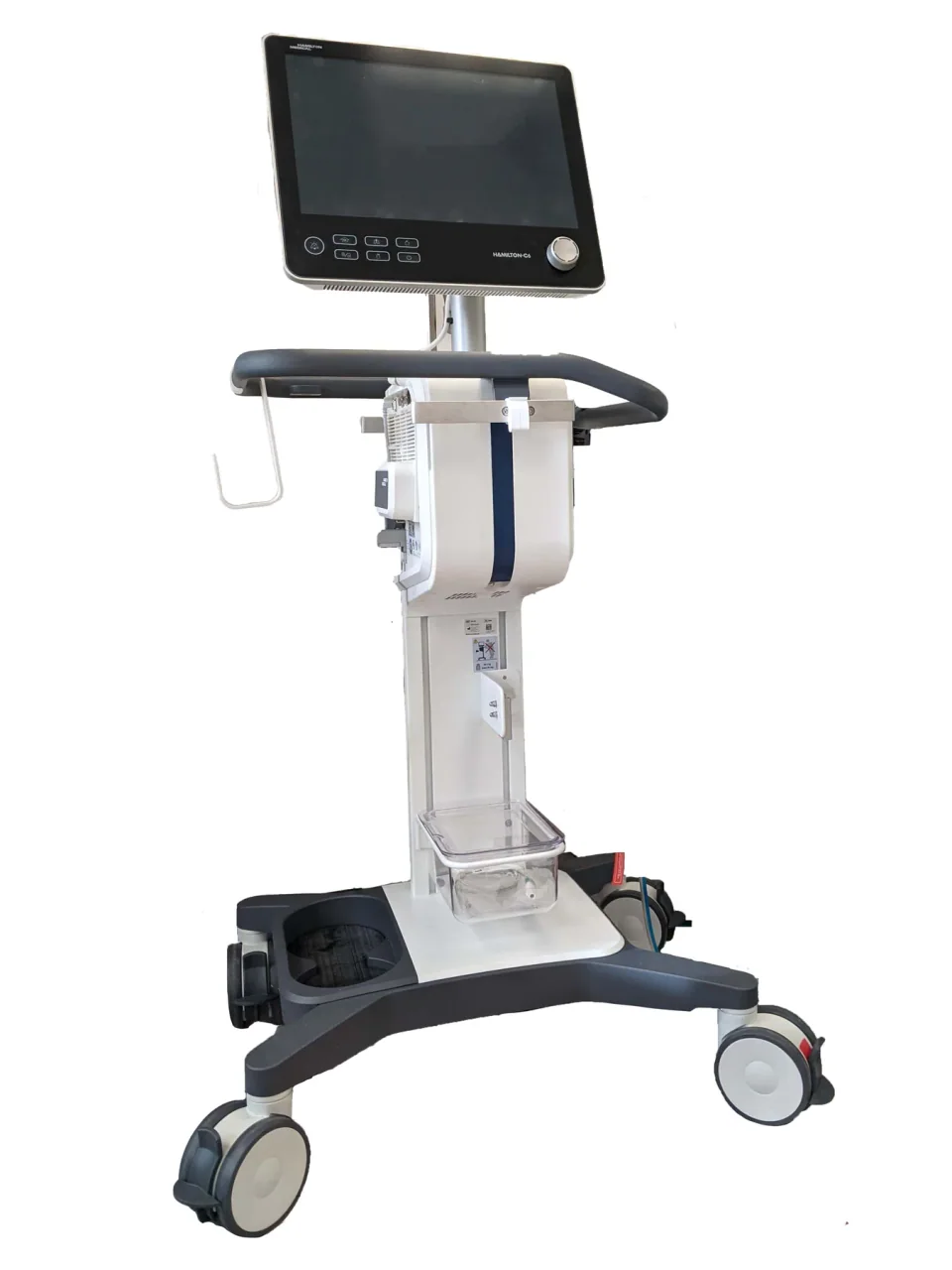
About this photograph
HAMILTON-C6, not the recommended C1 or T1; configuration and options not established.
The decision at a glance.
- Start here
- Without piped air, compare turbine-based HAMILTON-C1 and Savina 300 Classic. Savina's adult/pediatric scope may fit the ward; C1 deserves comparison when its compactness or purchased neonatal configuration matters.
- Spend more when
- Choose T1 when transfers need its mounting and battery arrangement. Consider pneumatic pNeuton Model A only with a funded compressed-gas and monitoring plan. Avoid building a new fleet around AVEA's ended service program.
- Watch the budget
- Include humidification, flow sensors, valves, circuits, batteries and oxygen. Savina's longer advertised autonomy includes an external battery; published runtime does not establish endurance of a used battery.
- Check the support
- Check Hamilton circuit item/lot numbers and applicable software and control-board corrections separately. New circuits alone do not settle the correction history of a used C1 or T1.
Ask the supplier
- Which patient groups, modes and monitoring options are enabled?
- What oxygen input and complete battery arrangement does this package need?
- Which serial, software and circuit corrective actions are documented as complete?
A cheap AVEA is a transition decision
Vyaire's September 23, 2024 customer letter changes the AVEA calculation. It discontinued AVEA, ReVel, SiPAP and VELA capital equipment, technical training, field service and factory orders globally, with remaining consumables and parts limited by availability. A hospital already maintaining AVEA may reasonably use its known fleet while replacing it in stages. A hospital starting from nothing would be buying the maintenance problem as well as the ventilator. The useful question is how many supported service-years the offered unit can still provide, not how far its price has fallen.
LTV needs a different answer: ZOLL's current technical-support page includes that family. That is a real route to investigate, although it does not establish repairability of every LTV 1000 or 1200. Make the offered serial, service kits and remaining repair horizon the deciding evidence. AHP300 remains unresolved because current OEM support was not confirmed. Keep or accept an older machine for a documented role; do not expand a fleet simply because earlier equipment notes liked the model.
Match bedside and transport capability to the actual work
C1 and Savina address the same expensive infrastructure problem: both use a turbine rather than requiring central compressed air. They still need an adequate supplemental oxygen source. Compare them beside the proposed oxygen supply and backup-power plan, not as isolated consoles. Savina's stated internal battery is 45 minutes; its longer advertised autonomy uses an external battery. C1's published four-hour figure is also a specification under stated conditions, not a promise that an aged battery will cover any outage.
C1’s purchased neonatal configuration or smaller footprint can fill a real service gap; whether that justifies any additional quoted cost depends on the complete competing packages. Savina’s adult/pediatric scope can be enough for a ward that will not use neonatal modes. T1 belongs in the comparison for intra-hospital as well as inter-facility transfers when mounting, battery changes and transport operation meet the route’s needs. A hospital with mostly stationary beds may gain more from a complete spare bedside unit than from transport features on each bed. Compare complete offers before making that budget tradeoff; it is not a failure-rate claim.
For pNeuton Model A, avoiding electrical dependence shifts the purchase toward compressed-gas logistics. Calculate the complete transport arrangement, including regulator, gas, circuits and monitoring. Across all four options, price the replacement flow sensors, valves and humidification supplies that keep the station usable. An absent consumable can take a healthy ventilator out of service just as effectively as a fault.
The circuit lot and service record belong beside the serial number
The FDA's August 2026 update concerns certain Hamilton coaxial circuit sets whose expiratory valve membranes can adhere and impair gas flow. Affected sets are to be removed; this is not a statement that every C1 or T1 is recalled. It is a concrete reason to include circuit identifiers and lot verification in acceptance rather than inspecting the console alone.
Used C1 and T1 offers also need their older corrective-action history. FDA documented a 2023 software issue affecting specified versions with the neonatal option and a separate 2023 correction for affected control-board capacitors and spare parts. Neither is resolved merely by supplying new breathing circuits. Require the serial, installed software and hardware service record to establish which actions apply and have been completed.
Use the configuration demonstration and biomedical acceptance to settle what the offered unit can do now. Use a destination service commitment to settle how it will be maintained. Published battery figures, manuals and service portals support those decisions; none supplies a comparative failure rate. A well-documented refurbished unit can therefore remain a rational purchase, while a newer unit with an incomplete accessory package can still be poor value.
Compare the options.
HAMILTON-C1
- Capability
- Turbine; adult/pediatric and optional neonatal configurations; NIV and high flow
- Best fit
- Compact bedside fleet spanning defined care areas
- Cost to watch
- Patient-group licenses, sensors, humidification and battery provision
Dräger Savina 300 Classic
- Capability
- Adult/pediatric turbine platform; low-pressure oxygen; optional NIV and CO2
- Best fit
- Stationary beds with an accessible Dräger service route
- Cost to watch
- External battery and enabled monitoring/therapy options
HAMILTON-T1
- Capability
- Turbine transport platform with a hot-swappable battery arrangement
- Best fit
- Intra-hospital or inter-facility transfers whose mounting, battery and ventilation requirements fit the configured system.
- Cost to watch
- Mounting, spare battery and complete transport accessories
Airon pNeuton Model A
- Capability
- Pneumatic transport ventilation
- Best fit
- Transport service able to sustain the specified gas supply
- Cost to watch
- Compressed gas, compatible circuits and monitoring
Vyaire AVEA, existing fleet
- Capability
- Legacy platform with discontinued capital equipment and service
- Best fit
- Managed transition of known units; not a new-fleet default
- Cost to watch
- Finite parts, maintenance capacity and planned replacement
Model notes, pricing & support 4 options
HAMILTON-C1, quoted with required patient-group and therapy options
Compact bedside platform
- Best for
- Hospitals needing a compact turbine ventilator across more than one care area.
- Why consider it
- The current manufacturer page identifies an integrated turbine, adult/pediatric and neonatal configurations, invasive modes, NIV and high-flow therapy. A common platform can make a small fleet easier to train on and provision, if the purchased licenses and accessories actually cover the workload.
- The trade-off
- A base-unit quote can omit neonatal capability, monitoring or therapy options. Flow sensors, valves and humidification remain part of the system; four-hour published battery operation is not an outage guarantee.
- Price & package
- Quote required as of 2026-10-16; include software options, trolley, humidifier, sensors, batteries and starter circuits.
- Support
- Current manuals and product resources are published. Country-specific service, spare availability and end-of-support commitment were not confirmed. Check the 2026 coaxial-circuit recall by item and lot.
Dräger Savina 300 Classic
Adult/pediatric bedside alternative
- Best for
- Adult/pediatric services with accessible Dräger support and a preference for a larger bedside display.
- Why consider it
- Turbine operation and a low-pressure oxygen input reduce dependence on a central compressed-air installation. The US specification lists adult/pediatric use and identifies NIV, CO2 and several display capabilities as options.
- The trade-off
- Do not buy it as a neonatal ventilator. The listed internal battery is 45 minutes; the longer advertised autonomy includes the external battery. Optional functions must be itemized.
- Price & package
- Quote required as of 2026-10-16; compare the same NIV, CO2, external-battery and humidifier configuration.
- Support
- Current manufacturer product and documentation pages exist; local repair turnaround and parts horizon remain unverified.
HAMILTON-T1, with required transport and neonatal options
Dedicated transport capability
- Best for
- Teams moving ventilated patients within or between hospitals while maintaining the required modes and monitoring.
- Why consider it
- Hamilton documents a turbine, low-pressure oxygen connector and one integrated plus one hot-swappable battery. Its transport focus makes it a more coherent comparison than choosing an old unit only because it fits in a bag.
- The trade-off
- Transport mounting, batteries and consumables add to the purchase. Confirm the exact regional neonatal and high-flow options; a brochure for one software release cannot define every used T1.
- Price & package
- Quote required as of 2026-10-16; include approved mounting, charger, spare battery and complete transport circuit package.
- Support
- Current manufacturer transport resources and manuals are available. Contractual support at the destination remains unconfirmed; affected circuit lots must be excluded.
Airon pNeuton Model A
Pneumatic transport alternative
- Best for
- A program able to support a pneumatic transport ventilator and its specified oxygen supply.
- Why consider it
- The manufacturer still provides a Model A product page, operator manual and dedicated startup-kit information. Its pneumatic approach is worth quoting where avoiding electrical dependence has practical value.
- The trade-off
- Electrical simplicity shifts the burden to compressed gas, compatible circuits and the monitoring arrangement. It should not be assumed to duplicate a turbine ICU ventilator's interface, modes or neonatal capability.
- Price & package
- Quote required as of 2026-10-16; price the gas supply, regulator, circuits, mounting and monitoring as well as the unit.
- Support
- Public manufacturer documentation is confirmed. The manual specifies qualified/approved service; a local service route and current parts commitment were not confirmed.
Budget for the complete service.
Cost per available ventilator-bed day = (landed configured system + commissioning + training + service + replacement batteries/sensors + circuits and humidification + backup capacity) / days the required configuration is actually available.
- Oxygen generation or cylinder supply at required pressure and flow
- Batteries tested under the quoted load, including external packs
- Flow sensors, expiratory valves, circuits, filters and humidifier chambers
- Preventive maintenance, calibration equipment and qualified service travel
- Transport mounting and monitoring options
- Spare unit or turnaround cover during repair
Further checks & evidence limits
Questions to resolve
- What exact model, serial number, software release, patient groups and enabled options are on the offer?
- Will the manufacturer or authorized service organization support this serial number in the destination country, and for how long?
- What oxygen inlet specifications and measured consumption apply to the intended configurations?
- Can the vendor demonstrate operation, alarms and battery endurance with the complete delivered accessories before shipment?
What the evidence does not establish
- No comparable landed quotations or independent comparative failure rates were obtained.
- Original Esprit/V1000/V100 designation and neonatal claims remain unverified.
- AHP300 current OEM service and LTV 1000/1200 serial-specific support remain unresolved.
- Product pages confirm documentation and stated capabilities, not local service availability.
Sources & supporting evidence.
Manufacturer claims and seller offers are identified below. Prices apply to the stated offer and review date; confirm availability, configuration and delivered cost.
- HAMILTON-C1 current product and configuration resourcesHamilton Medical · manufacturer · checked October 16, 2026
Turbine; adult/pediatric and neonatal configurations; invasive, NIV and high-flow therapy; listed battery and options.
- HAMILTON-T1 transport ventilatorHamilton Medical · manufacturer · checked October 16, 2026
Transport platform for use inside and outside the hospital; turbine, low-pressure oxygen connection, battery configuration and regional options.
- Savina 300 Classic specificationsDräger · manufacturer · checked October 16, 2026
Adult/pediatric turbine platform; LPO inlet; 45-minute internal battery; optional NIV and CO2; external battery for longer runtime.
- pNeuton Model A manufacturer product pageAiron / Inspiration Healthcare · manufacturer · checked October 16, 2026
Model A current product presentation and startup-kit/documentation links.
- pNeuton Model A operator manualAiron · manufacturer · checked October 16, 2026
Pneumatic system, specified gas/circuit requirements and approved-service requirement; manual is not a current service contract.
- Vyaire ventilation product update, September 23, 2024Vyaire, manufacturer letter hosted by Medline · manufacturer · checked October 16, 2026
AVEA, ReVel, SiPAP and VELA capital equipment, technical training, field service and factory orders ended; limited parts/consumables subject to availability.
- ZOLL technical support product coverageZOLL · manufacturer · checked October 16, 2026
Current support page lists LTV ventilators; not a serial-specific commitment for all historical models.
- Hamilton coaxial breathing circuit recall, updated August 11, 2026FDA · regulator · checked October 16, 2026
Certain circuit item/lots have valve membrane adherence; removal recommended; not a recall of all C1/T1 consoles.
- Hamilton neonatal-option software correction, 2023FDA · regulator · checked October 16, 2026
Specified C1/T1 software versions with neonatal option affected by a prolonged-use software issue.
- Hamilton control-board capacitor correction, 2023FDA · regulator · checked October 16, 2026
Specified C1/T1/MR1 devices and spare control-board components subject to corrective action.
Put the guide to work.
Send MMS your equipment list, destination and budget. We can help you compare a complete package.
Discuss your equipment