
Buying a bladder scanner: the probe is only half the kit
A cheap used scanner can depend on a missing calibration route, charger or unsupported probe. Compare complete kits and current support before comparing the console price.
Editorially reviewed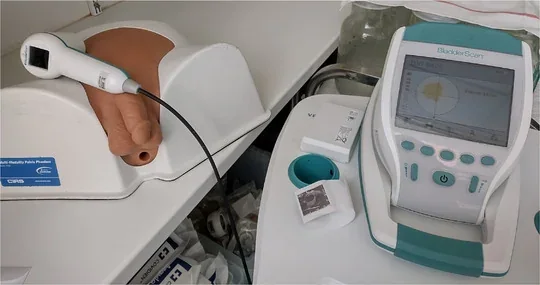
The decision at a glance.
- Start here
- Establish the intended patient population and complete device/probe/battery/calibration/records package.
- Spend more when
- The supported package removes a documented maintenance, supply or availability problem that a cheaper kit cannot resolve.
- Watch the budget
- Compare the full usable configuration and recurring supplies over one common period.
- Check the support
- A missing probe, calibration pathway or unresolved acceptance problem prevents the kit from providing its intended service.
Ask the supplier
- What current evidence supports this exact kit’s calibration and repair route?
- Which charger, battery, probe, printer and host/software are actually included?
- How will the accepted result reach the patient record?
Buy bladder-volume measurement, not an implied diagnostic upgrade
A dedicated bladder scanner should be selected for the defined bladder-volume task and intended patient population. It does not become a general diagnostic ultrasound system because it displays an image. Verathon’s i10 manual explicitly describes a measuring tool and excludes fetal use, pregnancy, suprapubic wounds and ascites. The clinical team must apply the exact current instructions and limitations to the intended service.
Do not turn a phantom accuracy specification into a guarantee for every patient. A test object, an internal self-test and clinical performance answer different questions. Procurement should secure appropriate training and acceptance evidence without inventing diagnostic claims or recommending catheterization thresholds.
The BVI 9400 support position changes the used-price comparison
Verathon’s current discontinued-device page says the BVI 9400 was discontinued in 2019 and is no longer supported. It also lists Prime Plus as discontinued in most geographies. These statements are more useful to a buyer than a seller’s broad promise of “online calibration”. They do not establish that every existing unit has failed, or that support arrangements are identical in every country.
The 9400 manual describes calibration at least every 12 months, using ScanPoint with QuickPrint or an authorized service-center route. The documented method is not proof that its software, account, host computer or service-center pathway remains available now. A seller must substantiate the actual continuing route. If that route cannot be established, do not build a new service around the low purchase price.
Different generations have different dependencies
The BVI 9400’s charger also serves as the wireless hub linking it to a ScanPoint host. Its console has an integrated thermal printer. A replacement charger that merely charges a battery may therefore leave another promised function unfulfilled; the offered kit needs its exact compatible parts and a demonstrated workflow.
For i10 and Prime Plus, Verathon’s calibration manual says routine calibration is not required under normal use and describes a dedicated tank when a facility requires calibration. That is a different maintenance proposition, not permission to ignore local requirements, damage or failed checks. The required tank, access permissions and qualified service response still belong in the plan.
A battery and a printer are purchasing choices
The i10 component tables separate the core console, probe, battery and power supply from optional items such as an external charger, extra battery, printer and workstation. Its manual states that examinations cannot be performed while connected to external power. A healthy battery and a workable charging arrangement are therefore essential to the service, even where mains power is reliable.
Choose the carrying and storage arrangement for the actual ward route. A shared device needs a reliable place to return, charge and clean; a scanner hidden in a locked room may have excellent technical availability and poor practical availability. Confirm who owns it between wards before buying a second unit to solve a retrieval problem.
Make the record leave the scanner correctly
The i10 supports an optional printer and USB PDF export. Export moves saved exams out of internal memory; it is not simply a second copy left on the console. Agree the approved destination, access and retention process with the hospital’s records team, and demonstrate the required patient identity and result handoff before acceptance.
Buy printing only if the workflow needs paper. Conversely, omitting a printer saves nothing when staff have no approved electronic route. Barcode, USB and paper are different ways to move information, and none automatically proves integration with the patient record.
Compare completed kits and the cost of keeping them usable
In a hypothetical comparison, a $2,000 used console requiring $900 of missing accessories and $400 of acceptance work costs $3,300 before service and continuity. A complete $3,500 alternative is only $200 more at that point. These are invented figures showing how to compare offers, not current scanner prices or permission to buy an unsupported unit.
A sound decision includes the probe replacement route, battery, approved cleaning supplies, required checks, staff training and time without the device. Retain a suitable accepted scanner when those dependencies are manageable. Replace it when the continuing-service case fails, rather than treating age alone or an “AI” label as the deciding evidence.
Compare the options.
BVI 9400 offer
- Capability
- Legacy kit with ScanPoint/hub and scheduled calibration dependencies
- Best fit
- Only a justified, qualified case; OEM says no longer supported
- Cost to watch
- Missing components and a demonstrable continuing-service route
Prime Plus offer
- Capability
- Different calibration arrangement; discontinued in most geographies
- Best fit
- A verified continuing-service proposition, not assumed current availability
- Cost to watch
- Exact regional support and full kit
i10 package
- Capability
- Battery-based examinations with optional print/export accessories
- Best fit
- A current supported package matched to the clinical task
- Cost to watch
- Battery plan, chosen accessories and service coverage
Budget for the complete service.
Full kit cost = delivered device + missing compatible components + acceptance/training + required checks, service, supplies and continuity over one common period. Evaluate usable exams separately from advertised scans per charge.
- Current support and calibration route
- Probe and battery replacement
- Print/export and host dependencies
- Shared-device access and cleaning
Further checks & evidence limits
Questions to resolve
- What current evidence supports this exact kit’s calibration and repair route?
- Which charger, battery, probe, printer and host/software are actually included?
- How will the accepted result reach the patient record?
What the evidence does not establish
- No exact used-unit acceptance, local support contract or current offer price established.
- BVI 9600/AortaScan diagnostic claims remain outside this recommendation; a bladder-volume comparison does not resolve that separate claim.
- No comparative patient accuracy, infection reduction or reliability ranking established. Manual sections were targeted to buying dependencies, not read as a complete operating course.
Sources & supporting evidence.
Manufacturer claims and seller offers are identified below. Prices apply to the stated offer and review date; confirm availability, configuration and delivered cost.
- Discontinued BladderScan devicesVerathon · manufacturer · checked October 18, 2026
BVI 9400 no longer supported; Prime Plus discontinued in most geographies.
- BladderScan i10 operations and maintenance, revision 08Verathon · manufacturer · checked October 18, 2026
Effective 18 June 2026; intended-use limits, component tables, battery/external-power constraint and report handling.
- BVI 9400 operations and maintenanceVerathon · manufacturer · checked October 18, 2026
Effective 6 June 2024 despite URL path; historical architecture/calibration requirements do not prove current service availability.
- i10 and Prime Plus calibration manual, revision 03Verathon · manufacturer · checked October 18, 2026
Effective 22 February 2023; normal-use calibration position and facility-required calibration kit/access dependencies.
Put the guide to work.
Send MMS your equipment list, destination and budget. We can help you compare a complete package.
Discuss your equipment