
Vascular ultrasound: a linear probe is not the whole package
Compare the examinations, Doppler work and reporting the service needs. A portable and a shared imaging cart can each be good value for different workloads.
Editorially reviewed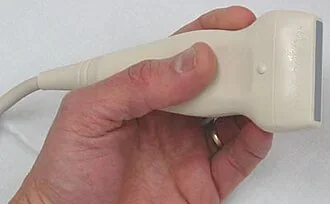
About this photograph
Not evidence of MMS stock, recommended options, current support, performance or endorsement.
The decision at a glance.
- Start here
- Define the vascular examinations and report, then compare complete named probe/mode/release packages.
- Spend more when
- A required function, reporting improvement or dedicated availability changes the service.
- Watch the budget
- Vascular service cost = accepted scanner/probes/options + reporting and setup + maintenance, staff workflow and continuity over the same period.
- Check the support
- A generic linear-probe or vascular label substitutes for demonstrated examination and report coverage.
Ask the supplier
- Which exact probes, modes and release meet the agreed vascular examination brief?
- Can the offered configuration complete the required report and image transfer?
- What access, probe repair and temporary-cover arrangements are included?
Define the vascular work before choosing the platform
A buyer should first separate the planned vascular examination service from a bedside device intended for a narrower task such as access guidance. Ask the vascular lead to define the examinations, patient range, measurements and reporting. A shared word in a product category does not make the equipment packages interchangeable.
Match the required work to probes and enabled functions. Keep any additional probe needed for a different depth or examination on its own line. The cheaper offer is not equivalent if it covers only the easiest part of the brief or requires an unpriced software addition to produce the intended report.
Use exact examples to test the offered configuration
GE’s August 2024 LOGIQ E10 image gallery identifies L2-9-D in a carotid PW waveform example. Its current product page also identifies that probe in a lower-extremity venous micro B-Flow example. Those illustrations support specific questions about the offered package; they do not prove every E10 includes the same probes, software or release.
For a compact alternative, the current Vivid iq page identifies L4-20t-RS and restricts that probe to Premium and 4D versions. That is a useful reason to check the version, even where the buyer does not need 4D cardiac work. A quotation headed simply “Vivid iq with linear probe” omits a distinction that can affect the purchase.
Make the report part of the demonstration
Have the qualified vascular team evaluate the complete task using its approved acceptance arrangements. Follow the required imaging and measurements through saved studies, labels and the report. Establish which values transfer into the reporting workflow and which still require manual entry. Count the actual steps before accepting a promised productivity advantage.
A demonstration on a supplier’s fully equipped unit should not settle a purchase of another configuration. Record the release, enabled options and probe used. If an advanced flow display is attractive, ask whether it changes a requirement in the clinical brief; otherwise compare it as an optional benefit rather than an assumed necessity.
A shared cart and a portable solve different access problems
A shared imaging cart may provide useful capability across departments and spread its ownership cost. It can also be unavailable when the vascular service needs it. A portable may remove that scheduling or location constraint while introducing its own display, battery, cart and transport requirements. Compare access to the complete package, not console weight alone.
Consider a service whose existing cart performs the required examinations but spends the planned vascular session in another department. A dedicated accepted package addresses access; buying another high-end option for the shared cart does not. Conversely, when availability is adequate, an additional supported probe or reporting connection may be the better investment.
Keep older systems in the comparison without inventing support
A working legacy platform with accepted probes and a credible repair route can remain useful. A low used price is less persuasive when essential transducers, analysis rights or support are uncertain. Assess console and probe condition separately and compare repair, replacement and temporary cover for the exact equipment.
The sources do not establish that a cheaper legacy model equals a newer platform’s clinical performance or has a longer useful life. Choose from demonstrated task completion, access and complete ownership cost. Pay more where it closes a named gap; retain the installed service where it already supplies the result the team needs.
Compare the options.
LOGIQ E10 with the required vascular package
- Capability
- OEM examples identify L2-9-D vascular imaging tasks.
- Best fit
- A service considering shared or dedicated cart capacity.
- Cost to watch
- Examples do not specify every offered release or included option.
Vivid iq Premium/4D with a verified L4-20t-RS package
- Capability
- OEM page states a version restriction for the named probe.
- Best fit
- A service needing an accepted portable vascular workflow.
- Cost to watch
- Do not infer equal clinical performance or buy unwanted options by default.
Retain or complete the accepted installed system
- Capability
- May preserve useful probes, reporting and staff familiarity.
- Best fit
- Adequate capability and access with a practical repair route.
- Cost to watch
- Exact support and unresolved limitations decide whether investment continues.
Option notes, costs & support 3 options
For every option
- Price & package
- Compare the complete configured package; no current matched price established.
- Support
- Confirm exact release, probe condition and destination repair eligibility.
LOGIQ E10 with the required vascular package
General-imaging cart comparison
- Best for
- A service considering shared or dedicated cart capacity.
- Why consider it
- OEM examples identify L2-9-D vascular imaging tasks.
- The trade-off
- Examples do not specify every offered release or included option.
Vivid iq Premium/4D with a verified L4-20t-RS package
Compact configuration comparison
- Best for
- A service needing an accepted portable vascular workflow.
- Why consider it
- OEM page states a version restriction for the named probe.
- The trade-off
- Do not infer equal clinical performance or buy unwanted options by default.
Retain or complete the accepted installed system
Existing-service comparison
- Best for
- Adequate capability and access with a practical repair route.
- Why consider it
- May preserve useful probes, reporting and staff familiarity.
- The trade-off
- Exact support and unresolved limitations decide whether investment continues.
Budget for the complete service.
Vascular service cost = accepted scanner/probes/options + reporting and setup + maintenance, staff workflow and continuity over the same period.
- Defined vascular examinations
- Probe and release differences
- Measurement-to-report workflow
- Shared versus dedicated access
Further checks & evidence limits
Questions to resolve
- Which exact probes, modes and release meet the agreed vascular examination brief?
- Can the offered configuration complete the required report and image transfer?
- What access, probe repair and temporary-cover arrangements are included?
What the evidence does not establish
- No independent head-to-head image-quality, reliability or price winner established.
- Model leads require exact configuration acceptance by qualified vascular staff.
Sources & supporting evidence.
Manufacturer claims and seller offers are identified below. Prices apply to the stated offer and review date; confirm availability, configuration and delivered cost.
- LOGIQ E10 clinical images, August 2024GE HealthCare · manufacturer · checked October 18, 2026
Published examples identify L2-9-D for carotid PW waveform and ML4-20-D for breast/shear-wave imaging. Demonstrated manufacturer examples are not inclusions of every unit or comparative performance evidence.
- LOGIQ E10 Series product pageGE HealthCare · manufacturer · checked October 18, 2026
Current public examples include ML4-20-D breast 2D shear-wave and L2-9-D lower-extremity venous micro B-Flow. Specific offered release, licences and probe condition remain purchase checks.
- Vivid iq: manufacturer product description and limitationsGE HealthCare · manufacturer · checked October 18, 2026
Current public body identifies M5Sc, analysis/reporting tools and release-dependent features; manufacturer performance and testimonial claims are not independent findings. No current matched price or all-unit entitlement established.
Put the guide to work.
Send MMS your equipment list, destination and budget. We can help you compare a complete package.
Discuss your equipment