
Monitor sensors, cables and cuffs: buy the complete connection
A matching plug can still leave the wrong sensor, missing trunk cable or unsuitable cuff in the box. Three exact Philips examples show how to compare the complete order.
Editorially reviewed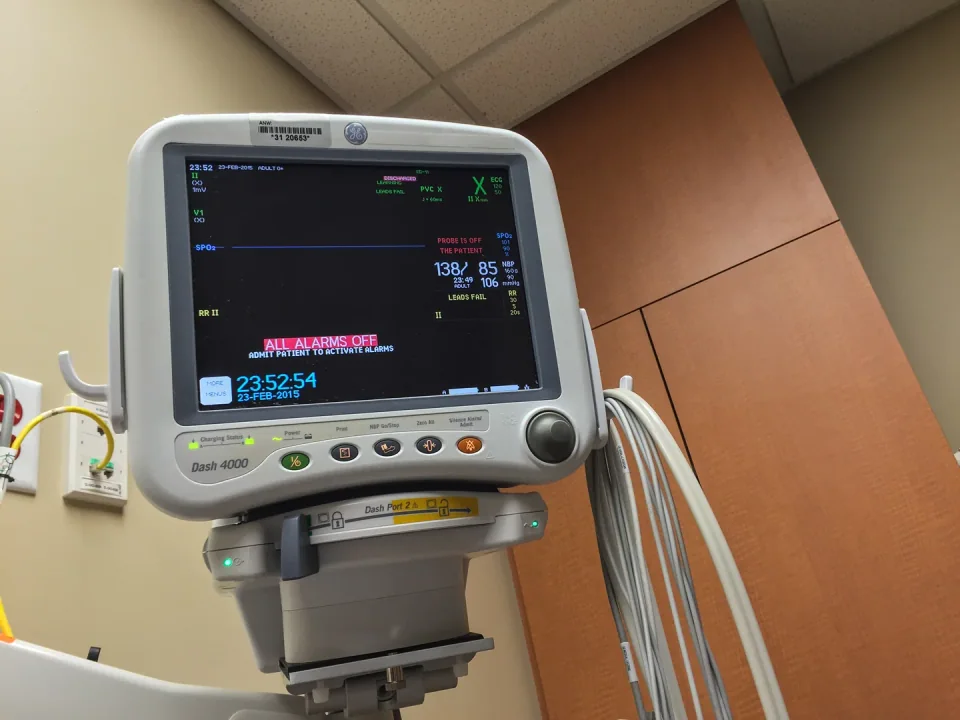
About this photograph
This archive photograph illustrates the equipment setting; it does not show or verify the exact device, configuration or service compared in this article.
The decision at a glance.
- Start here
- Identify the actual monitor/module and failed component, then order the approved chain with explicit sizes and package quantities.
- Spend more when
- A complete kit or additional stock closes a verified missing-component or availability gap.
- Watch the budget
- Accessory cost per usable item = complete order, freight and applicable charges divided by the usable supplied quantity; include required replacement and processing costs over a common period.
- Check the support
- Compatibility rests only on a photograph, broad brand name or connector appearance.
Ask the supplier
- What exact monitor/module and accessory chain does this part support?
- What patient-size range, connector and reusable or single-patient status apply?
- How many usable items are in the sales unit, and which required components are separate?
Identify the failed item before replacing the chain
Start with the technical team’s diagnosis and the identity of the installed monitor and measurement module. Record the working accessory chain before ordering a replacement. Replacing a damaged sensor does not necessarily require a new extension cable, while buying another sensor will not resolve a failed cable or incompatible module.
Then compare like-for-like complete orders. A low component price becomes poor value when the hospital must order a missing connector or replace an unsuitable patient interface. A photograph and a broad brand name are useful identification aids, but they should not substitute for documented compatibility with the actual equipment.
SpO2: follow the technology through the extension cable
Philips lists M1941A as a 2-metre, 8-pin-to-8-pin extension cable for Philips FAST sockets. Its compatible sensor list includes M1191B and M1192A, among other specified parts. The package contains one cable; the listing does not promise a sensor or make this an extension for every Philips monitoring configuration.
The practical buying chain is monitor or module technology, approved extension if required, then approved sensor for the intended patient and use. Check every link. An apparent connector match alone cannot settle that chain, and a generic “SpO2 cable included” description is too vague to establish what a monitor quotation actually supplies.
ECG: distinguish the trunk cable from the lead set
Philips 989803173131 is a five-lead, AAMI grabber, 1-metre disposable bedside lead set. The product page names compatible trunk cables including M1668A, M1663A and M1949A. The lead set and trunk are separate purchasing items; a new set of leads is not a complete patient-cable system by itself.
Quantity matters just as much as connection. This sales unit contains 20 individually wrapped single-patient sets. Compare a box price with a box price, or divide by the actual usable quantity before comparing unit costs. Do not mistake one sales unit for one lead set or assume that single-patient and reusable products have the same ongoing cost.
Blood-pressure cuffs: use the patient range and the connection
The M1574A adult cuff, also identified as 989803104171, is specified for a limb circumference of 27–35cm. Philips separately lists bladder dimensions of 13cm by 28cm. Those dimensions are not an alternative patient-size range. “Adult” alone is therefore an inadequate line item for an order serving a particular patient population.
The same specification identifies a single-hose, bayonet connection and one cuff per sales unit. Confirm the approved hose and monitor connection as well as the intended size range. A page listing other supplies does not mean they arrive in the cuff package. Keep the cuff, any required hose and their quantities explicit.
Standardize only after the complete combination is accepted
For a mixed fleet, build a short approved ordering record for each actual configuration. Include the exact accessory chain, intended patient range, reusable or single-patient status, package quantity and replacement part numbers. Have technical and clinical staff approve any proposed substitute and its model-specific handling and processing requirements.
Where practical, accept a small initial order before buying a large stock. Confirm identity, completeness and function through the hospital’s normal release process. Standardization can simplify replenishment when equipment really shares an approved chain; forcing a similar-looking accessory across incompatible modules simply creates a larger wrong order.
Compare the options.
Replace the diagnosed component
- Capability
- Preserves suitable existing cables and patient interfaces.
- Best fit
- A verified compatible chain with one failed or missing item.
- Cost to watch
- The diagnosis and exact part must be established first.
Order a complete approved chain
- Capability
- Makes sensor, extension or trunk, patient interface and quantities explicit.
- Best fit
- New installations or a chain with missing or unsuitable components.
- Cost to watch
- Do not pay twice for working components already present.
Standardize approved fleet combinations
- Capability
- Can reduce ordering ambiguity and stock fragmentation.
- Best fit
- Several units with documented matching configurations.
- Cost to watch
- Shared brand or connector appearance is insufficient evidence.
Option notes, costs & support 3 options
For every option
- Price & package
- Compare the full order and the number of usable items; no current matched price established.
- Support
- Confirm the exact approved accessory chain and replacement availability.
Replace the diagnosed component
Smallest complete repair
- Best for
- A verified compatible chain with one failed or missing item.
- Why consider it
- Preserves suitable existing cables and patient interfaces.
- The trade-off
- The diagnosis and exact part must be established first.
Order a complete approved chain
Resolve a genuinely incomplete package
- Best for
- New installations or a chain with missing or unsuitable components.
- Why consider it
- Makes sensor, extension or trunk, patient interface and quantities explicit.
- The trade-off
- Do not pay twice for working components already present.
Standardize approved fleet combinations
Replenishment improvement
- Best for
- Several units with documented matching configurations.
- Why consider it
- Can reduce ordering ambiguity and stock fragmentation.
- The trade-off
- Shared brand or connector appearance is insufficient evidence.
Budget for the complete service.
Accessory cost per usable item = complete order, freight and applicable charges divided by the usable supplied quantity; include required replacement and processing costs over a common period.
- SpO2 technology and extension
- ECG trunk versus lead set
- Cuff limb range and hose connection
- Sales unit versus usable quantity
- Approved fleet standardization
Further checks & evidence limits
Questions to resolve
- What exact monitor/module and accessory chain does this part support?
- What patient-size range, connector and reusable or single-patient status apply?
- How many usable items are in the sales unit, and which required components are separate?
What the evidence does not establish
- The three OEM examples are specific products, not a compatibility matrix for all monitors or regions.
- Actual module/revision and approved handling need confirmation before order or use.
- The previously reviewed Avante catalogue p.95 patient-range discrepancy remains unresolved for those catalogue entries; no disputed ranges copied or guessed.
- No current matched prices or claims of superior third-party/OEM reliability established.
Sources & supporting evidence.
Manufacturer claims and seller offers are identified below. Prices apply to the stated offer and review date; confirm availability, configuration and delivered cost.
- M1941A SpO2 extension cable specificationsPhilips · manufacturer · checked October 18, 2026
Product and specification table read: 2m, 8-pin to 8-pin, Philips FAST sockets, named compatible sensors and one cable per package. Marketing-text M1141A typo not adopted; identity follows title/specification. Not universal Philips compatibility.
- 989803173131 disposable ECG lead set specificationsPhilips · manufacturer · checked October 18, 2026
Product/specifications read: 5-lead bedside AAMI grabber, 1m, shielded, single-patient use; sales unit 20 individually wrapped sets. Named compatible trunks include M1668A, M1663A and M1949A. This does not establish compatibility with every monitor or trunk.
- M1574A adult cuff specificationsPhilips · manufacturer · checked October 18, 2026
Full specification table read: M1574A/989803104171 adult multi-patient cuff, limb circumference 27–35cm, single hose/bayonet, one cuff per sales unit. Bladder width 13cm and length 28cm are different fields. No assumption that listed other supplies are included.
Put the guide to work.
Send MMS your equipment list, destination and budget. We can help you compare a complete package.
Discuss your equipment