
Buying routine CT: when are more slices worth paying for?
Compare detector coverage, generator power, table capacity and applications against the examinations your hospital will actually perform.
Editorially reviewed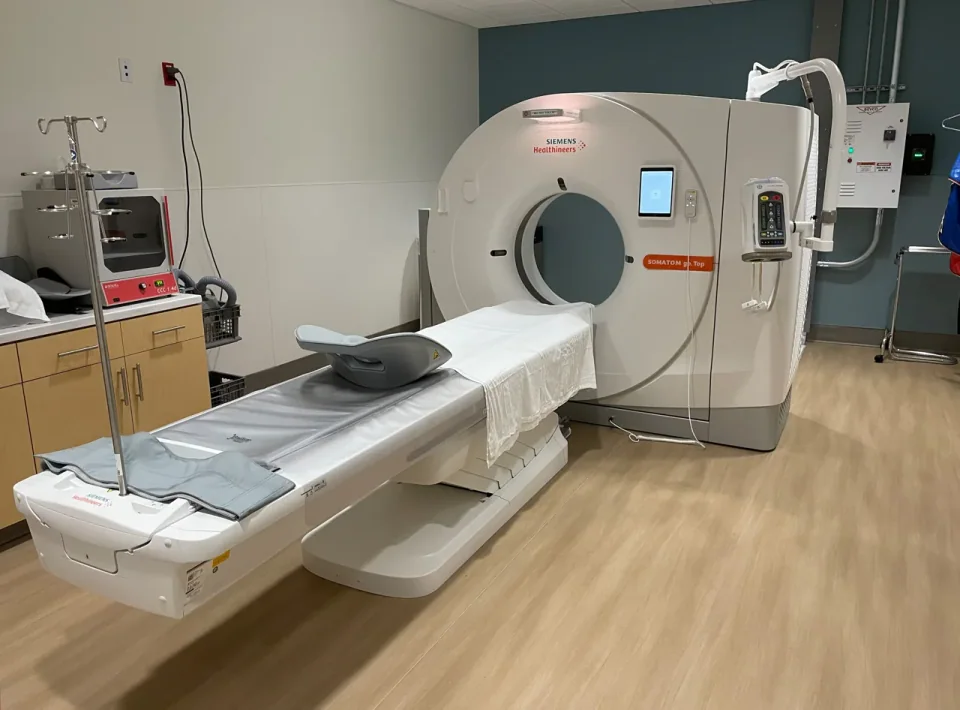
About this photograph
Not evidence of MMS stock, recommended options, current support, performance or endorsement.
The decision at a glance.
- Start here
- Match the configuration to routine work the hospital will retain.
- Spend more when
- The upgrade removes a specific accepted limitation.
- Watch the budget
- Include options, site works and tube exposure.
- Check the support
- Review the offered system and restoration route.
Ask the supplier
- Which accepted examination requires each proposed upgrade?
- What physical coverage, table and applications are actually included?
- What limits the number of completed examinations today?
Start with the work that stays in the hospital
List the examinations the service will provide, the approximate daily mix and the studies it will continue to refer. Have the clinical team define the required patient range and image quality. A first scanner for routine work and a replacement intended to expand a specialist service are different purchases.
Keep cardiac CT, CT-guided procedures and radiotherapy simulation as explicit additions to that brief. Buying a scanner that can be advertised for many applications does not automatically buy the staff, accessories, licences or quality programme for all of them.
Read the physical coverage behind the slice label
Siemens' published go.Now table lists 32 slices but physical z-coverage of 16 × 0.7 mm. Its go.Top table lists 128 slices with 64 × 0.6 mm coverage. The advertised slice count and physical detector coverage are therefore different quantities. Ask for both, rather than treating every 32- or 128-slice offer as equivalent.
The same two examples list 32 kW and 75 kW respectively, while both have a 70 cm bore. A higher-tier purchase can change power and coverage without changing the opening through which the patient passes. These are configuration differences for the clinical team to evaluate, not universal minimum specifications or proof that one system is right for every routine service.
Make the upgrade solve a named limitation
Require each proposed extra to answer a simple sentence: this capability is needed for this part of our accepted workload. Greater coverage may matter to the intended acquisition; a higher-capacity table may matter to the patient population; additional processing may matter to the reporting task. Test those requirements on the exact offered configuration.
Optional equipment is especially easy to lose between a demonstration and a purchase order. go.Top's published fastest rotation and higher table capacity are options. Record the installed version, enabled applications and table specification separately. An attractive family brochure is not evidence that a used unit includes them.
Time the complete examination, including the queue
A scanner upgrade has little scheduling value if registration, patient preparation, IV access, reporting or transport determines the daily total. Observe the existing workflow or build a realistic schedule for the proposed service. Include contrast and non-contrast work, room turnover and interruptions.
For example, in a hypothetical eight-hour day, saving two minutes on each of 20 examinations releases 40 minutes. It does not create another 20 appointments. Count any extra completed work only after the rest of the pathway can use that time; otherwise the benefit is less congestion or staff capacity, not additional scan revenue.
Reconstruction belongs in acceptance, not just the sales demonstration
AAPM's protocol-management guidance emphasizes continuing review of image quality and dose for the clinical task. An installed reconstruction package needs that same local evaluation. A striking selected image or a vendor's percentage dose claim does not establish the result for the hospital's patient mix.
Include protocol setup, applications training, image transfer and the required physics work in the opening plan. Keep a usable configuration record and baseline acceptance evidence so later software or hardware changes can be assessed against the service that was bought.
The economical scanner is the one the budget can keep working
Compare the installed price, site works, tube exposure, injector supplies, software, maintenance and interruption provision over the same period. A low purchase price can still be sensible, but only after its exclusions are visible. Keep the tube-risk calculation separate from assumptions about how long a particular tube will last.
Retain an accepted existing scanner when a targeted repair or workflow change resolves the problem more economically. Replace it when the required capability or support is no longer sustainable. Public specifications can narrow the shortlist; actual condition, service rights and installed performance decide the offered machine.
Compare the options.
go.Now example
- Capability
- Lower-tier configuration.
- Best fit
- Routine brief accepted by clinical team.
- Cost to watch
- Required applications and installed scope.
go.Top example
- Capability
- Different coverage, power and options.
- Best fit
- A named limitation justifies spending.
- Cost to watch
- Useful incremental capability.
Retain
- Capability
- Existing accepted service.
- Best fit
- Scanner replacement does not solve the bottleneck.
- Cost to watch
- Repair and future support.
Option notes, costs & support 3 options
SOMATOM go.Now, specified configuration
Routine-work candidate
- Best for
- A clinical brief accepted on the offered coverage and power.
- Why consider it
- Provides a concrete lower-tier architecture to compare.
- The trade-off
- Slice label does not describe physical coverage.
- Price & package
- Complete installed system and required applications.
- Support
- Establish exact local service scope.
SOMATOM go.Top, specified options
Capability expansion candidate
- Best for
- The accepted work justifies its additional capability.
- Why consider it
- Different coverage and power, with selectable options.
- The trade-off
- Do not assume optional rotation or table capacity is installed.
- Price & package
- Options, site and tube/support exposure.
- Support
- Compare the actual unit, not the family maximum.
Retain the accepted scanner
Target the bottleneck
- Best for
- A repair or workflow change resolves the limitation.
- Why consider it
- Avoids replacing useful capacity unnecessarily.
- The trade-off
- Only appropriate with satisfactory performance and sustainable support.
- Price & package
- Targeted remedy and continued ownership.
- Support
- Use actual history and a credible restoration route.
Budget for the complete service.
CT value = accepted completed work supported by the full installed and recurring budget.
- Useful coverage and power
- Patient and table requirements
- Applications
- Tube and service exposure
- Workflow bottlenecks
Before you commit.
- Define retained and referred work.
- Separate slices from coverage.
- List options by installed configuration.
- Test complete workflow.
- Compare installed cost and interruption exposure.
Further checks & evidence limits
Questions to resolve
- Which accepted examination requires each proposed upgrade?
- What physical coverage, table and applications are actually included?
- What limits the number of completed examinations today?
What the evidence does not establish
- No universal clinical minimum, price ranking, tube-life estimate or measured reliability comparison.
- A family specification does not verify an offered unit.
Sources & supporting evidence.
Manufacturer claims and seller offers are identified below. Prices apply to the stated offer and review date; confirm availability, configuration and delivered cost.
- SOMATOM go.Now technical specificationsSiemens Healthineers · manufacturer · checked October 18, 2026
Published US table: 32 slices, 16 x 0.7 mm z-coverage, 32 kW and 70 cm bore. Options and local configuration require confirmation.
- SOMATOM go.Top technical specificationsSiemens Healthineers · manufacturer · checked October 18, 2026
Published US table: 128 slices, 64 x 0.6 mm z-coverage, 75 kW and 70 cm bore; fastest rotation and higher table capacity are optional.
- Medical Physics Practice Guideline 1.b: CT protocol management and reviewAmerican Association of Physicists in Medicine · professional-society · checked October 18, 2026
2021 public overview supports ongoing protocol management and review to match image quality, dose and clinical task. Full guideline not audited.
Put the guide to work.
Send MMS your equipment list, destination and budget. We can help you compare a complete package.
Discuss your equipment