
PET/CT: prove the tracer route before buying the scanner
Compare PET/CT packages only after testing the radiopharmaceutical supply, usable schedule and full facility cost.
Editorially reviewed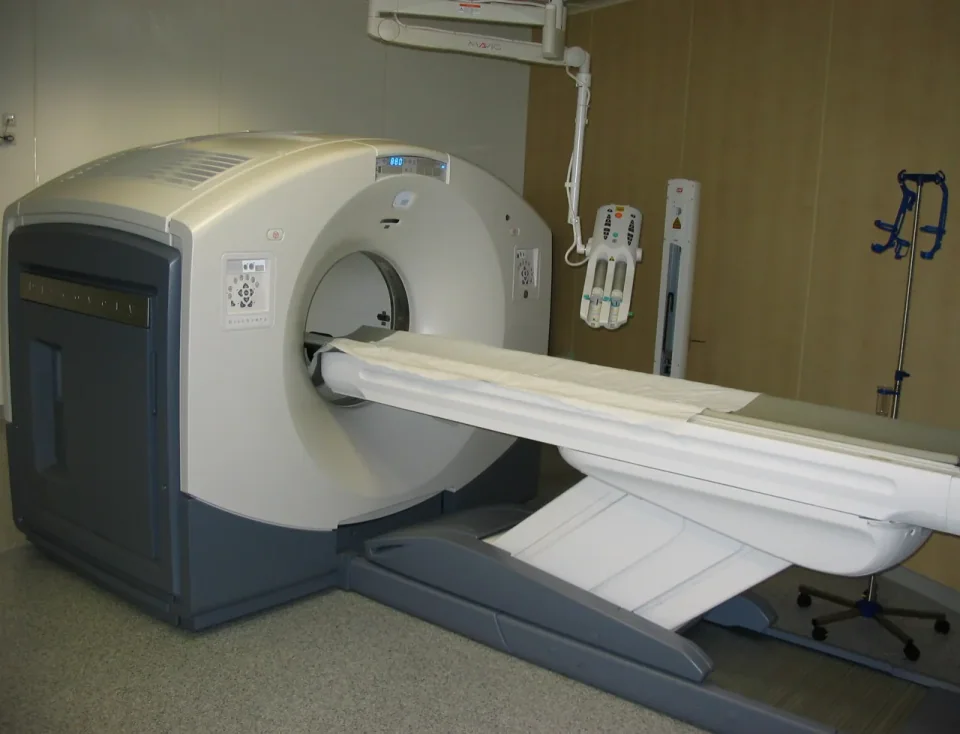
About this photograph
Not evidence of MMS stock, recommended options, current support, performance or endorsement.
The decision at a glance.
- Start here
- Prove the accepted tracer route and schedule first.
- Spend more when
- The proposed configuration solves an accepted clinical or capacity need.
- Watch the budget
- Include tracer commitments, supporting spaces and both imaging subsystems.
- Check the support
- Verify PET, CT and software coverage separately.
Ask the supplier
- Which tracer deliveries and backup arrangements support the real schedule?
- What exact PET, CT and application configuration is included?
- Which local bottleneck would the proposed upgrade remove?
The supply route decides whether the service can open
A first PET/CT purchase has a dependency that ordinary CT does not: the approved radiopharmaceutical must reach the service in a usable, authorized form on the intended scanning days. IAEA's PET planning guide treats reliable tracer supply as a prerequisite and distinguishes external supply from on-site production. A cyclotron project is a separate production undertaking, not a missing scanner accessory.
Build the opening schedule around the tracers the clinical service needs and can actually obtain. Test the proposed delivery route and interruption plan before ordering the scanner. A convenient distance on a map does not establish dependable deliveries or local authorization.
Digital PET does not describe one technology
Two current examples show why a single label is insufficient. Siemens describes Biograph Vision with SiPM-covered LSO crystals and hardware time-of-flight capability. GE describes Omni Legend with digital dBGO detectors and Precision DL processing designed to deliver benefits associated with time-of-flight. Software processing and measured timing hardware should remain separate lines in the comparison.
This distinction does not establish a clinical winner. Ask the physician and physicist to compare the proposed configurations for the accepted tasks, reconstruction methods and patient population. Do not divide one vendor's effective-sensitivity headline by another vendor's NEMA sensitivity figure and call the result a throughput or dose advantage.
Specify PET, CT and applications separately
Write three parts of the offer: the exact PET detector configuration, the CT subsystem, and the enabled applications. Biograph Vision's published table includes CT options as well as PET specifications. GE's Omni page identifies Dynamic IQ as required for its whole-body dynamic processing example. A family brochure can describe features absent from the offered system.
The clinical brief should say what the CT component must do, including whether diagnostic CT work is intended. Price the necessary injector, protocols, reporting and supporting workflow accordingly. Do not assume that paying for a PET/CT system automatically buys the same usable CT service as a separately specified diagnostic scanner.
Buy usable appointments, not a short demonstration scan
Trace the day through arrival, preparation, uptake space, scanning, image review and departure. IAEA's planning material includes these supporting areas alongside the scanner room. The facility team must design the actual site under current local requirements; historical example dimensions are not an approval.
Suppose a hypothetical schedule can support 12 completed appointments, but tracer supply reliably supports only eight. A scanner with capacity for another four does not create four usable appointments. Likewise, faster acquisition has limited scheduling value when preparation spaces, staff or reporting determine the daily total. Test a full-day schedule rather than extrapolating a selected clinical image.
Compare a complete service with external access
Referral or contracted PET/CT access deserves a serious comparison when demand is uncertain or supplies are fragile. Include transport, waiting, interpretation, records and continuity of care. A locally owned system can improve access only if its recurring operation is sustainable.
For ownership, separate fixed costs from the costs of each completed examination and from losses when an appointment cannot proceed. Include tracer commitments, staffing, quality work, premises, PET and CT maintenance, software and interruption provision. Record who absorbs a missed delivery, scanner failure or late cancellation rather than assuming the machine's warranty covers it.
Where extra spending can earn its place
More capable hardware or processing is worth evaluating when the clinical team identifies an accepted task or a demonstrated capacity limit. Existing equipment may remain the better investment if its work is satisfactory and the limiting factor lies elsewhere. Neither a digital badge nor a newer reconstruction package proves lower repair risk.
Choose the package after the clinical evaluation, complete installed scope and supply-dependent schedule agree. Keep any claimed scan-time or tracer savings conditional on the validated local workflow. That produces a defensible buying decision without inventing a universal price or winner.
Compare the options.
Vision package
- Capability
- Hardware TOF with specified PET/CT options.
- Best fit
- Accepted tasks justify the package.
- Cost to watch
- Complete configuration and service.
Omni package
- Capability
- dBGO detection and specified processing.
- Best fit
- Accepted workflow demonstrates value.
- Cost to watch
- Detector and software scope.
External service
- Capability
- Access without local scanner ownership.
- Best fit
- Local feasibility is not yet established.
- Cost to watch
- Travel, continuity and service charges.
Option notes, costs & support 3 options
Biograph Vision, exact PET/CT configuration
Hardware TOF example
- Best for
- A service whose accepted brief values the specified detector and CT package.
- Why consider it
- Published architecture separates SiPM/LSO detection, timing and CT options.
- The trade-off
- Marketing sensitivity measures are not directly interchangeable with every rival metric.
- Price & package
- Detector configuration, CT options, applications and service.
- Support
- Confirm regional availability and exact offered support.
Omni Legend, exact detector and software configuration
Digital dBGO and processing example
- Best for
- A clinical team accepting the offered reconstruction and examination scope.
- Why consider it
- Shows why processing rights and detector configuration need separate specification.
- The trade-off
- Do not treat software benefits as identical hardware timing capability.
- Price & package
- Complete system and required application licences.
- Support
- Verify installed applications and local repair coverage.
Contracted PET/CT access
Supply and fixed-cost alternative
- Best for
- Demand or local tracer logistics cannot sustain ownership.
- Why consider it
- Avoids committing to an incomplete service.
- The trade-off
- Access and onward information flow still need management.
- Price & package
- Completed pathway including travel.
- Support
- Agree continuity when a session is cancelled.
Budget for the complete service.
PET/CT cost per completed study = annualized site, equipment, staff, quality, support and tracer costs / completed accepted studies.
- Tracer availability
- Uptake and staffing capacity
- PET and CT configuration
- Software rights
- Cancelled-session exposure
Before you commit.
- Approve tracer and examination scope.
- Test the supply route.
- Separate detector, CT and software specifications.
- Model the whole appointment day.
- Compare external access and interruption costs.
Further checks & evidence limits
Questions to resolve
- Which tracer deliveries and backup arrangements support the real schedule?
- What exact PET, CT and application configuration is included?
- Which local bottleneck would the proposed upgrade remove?
What the evidence does not establish
- No tracer dosing, transport authorization or facility-design approval.
- No head-to-head clinical superiority, measured reliability or current prices.
- IAEA selected historical planning text does not establish present local rules.
Sources & supporting evidence.
Manufacturer claims and seller offers are identified below. Prices apply to the stated offer and review date; confirm availability, configuration and delivered cost.
- Planning a Clinical PET Centre, Human Health Series 11International Atomic Energy Agency · international-agency · checked October 18, 2026
2010 planning publication: selected facility and radiopharmaceutical supply sections read. Used for durable service dependencies, not current room sizes, transport-hour limits, prices or regulatory requirements.
- Omni Legend PET/CTGE HealthCare · manufacturer · checked October 18, 2026
Digital dBGO detector and Precision DL description; named Q.Clear, MotionFree and Dynamic IQ dependency footnote. Phantom and model-observer marketing not converted into clinical savings.
- Biograph Vision PET/CTSiemens Healthineers · manufacturer · checked October 18, 2026
SiPM/LSO hardware with time-of-flight; configuration table and optional CT features read. Manufacturer performance claims not a head-to-head clinical or reliability study.
Put the guide to work.
Send MMS your equipment list, destination and budget. We can help you compare a complete package.
Discuss your equipment