
SPECT or SPECT/CT: will the extra scanner earn its keep?
Compare a nuclear-only camera with a hybrid system by the accepted examinations, collimators, software and added CT obligations.
Editorially reviewed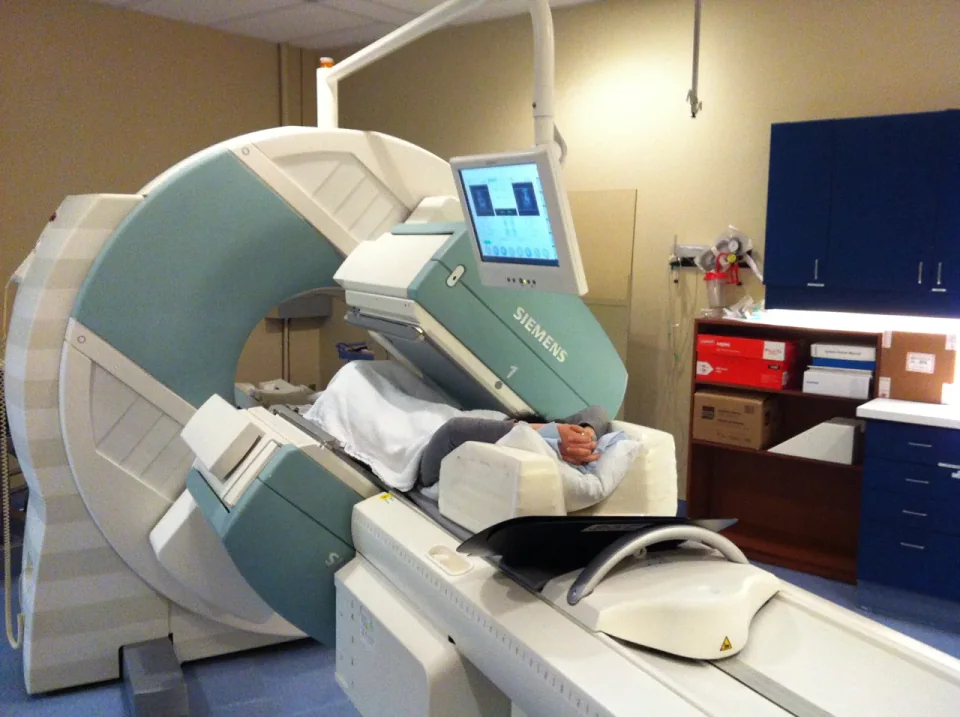
About this photograph
Not evidence of MMS stock, recommended options, current support, performance or endorsement.
The decision at a glance.
- Start here
- Choose the architecture from the accepted examination list.
- Spend more when
- Integrated CT adds a capability the programme can use.
- Watch the budget
- Compare collimators, software and both hybrid subsystems.
- Check the support
- Require exact corrective-action status and installed acceptance evidence.
Ask the supplier
- Which examinations require integrated CT and what CT capability?
- Which collimators, crystal configuration and applications are included?
- Who accepts and supports each subsystem and their integration?
Decide what the CT component contributes
A SPECT-only camera and a SPECT/CT system should be compared against the examinations the nuclear medicine team intends to perform. For each, record whether integrated CT has a necessary accepted role and what capability that role requires. Do not buy the CT label first and invent a workload to justify it later.
PET/CT is a separate clinical and supply decision, not simply the premium tier of this purchase. Keep the nuclear medicine programme's actual tracer, staffing and referral requirements attached to each proposed route. A change in imaging architecture does not make every service interchangeable.
NM 830 and Pro.specta illustrate the real package difference
GE's NM 830 is a dual-head SPECT-only example. Siemens' Symbia Pro.specta combines SPECT with CT and lists 32/64 CT configurations in its US technical table. The hybrid therefore adds a CT subsystem to the equipment and support scope; its usefulness depends on the clinical brief.
For a service whose accepted work does not require integrated CT, nuclear-only equipment avoids purchasing that extra subsystem. When integrated CT answers a defined need, compare its exact configuration and workflow with the nuclear-only route plus any required separate imaging. These examples establish architectures, not a current price ranking or a recommendation for every patient group.
The collimator and software list can change the offer
GE describes SwiftScan in conjunction with a named LEHRS collimator and acquisition or processing combinations. A generic camera price is therefore incomplete for a task that depends on that package. Require the actual collimator set, handling equipment and enabled reconstruction applications rather than assuming every brochure capability is included.
Pro.specta's table also lists alternative crystal thicknesses. Have the clinical and physics teams specify the appropriate detector, collimator and application combination for the intended work. Do not infer universal isotope capability or local quantification performance from a family-level claim.
A working image is not an acceptance record
IAEA's SPECT quality guidance distinguishes acceptance tests from the reference measurements used to judge later performance. For procurement, the practical point is to agree the required evidence and test resources before purchase. The relevant team should establish the actual programme for this system and its use.
A used camera's sale should include an identifiable configuration, service history and an agreed installed acceptance process. Budget the phantoms, authorized sources, software, qualified personnel and time needed for the local quality programme. A seller demonstration cannot replace the evidence that the relocated system meets the accepted specification.
Hybrid support needs a named boundary
Price support for the nuclear detectors, gantry and motion systems, collimators, processing workstation and software. For SPECT/CT, add the CT tube, generator, detector, calibration and integration responsibilities. Identify which provider owns a fault that crosses the two systems.
Compare the complete service scope over the same period, including exclusions and restoration work after component replacement. A lower annual contract can be poor value if a major hybrid component is outside it. Public service-course listings and claims of parts access are evidence of possible serviceability, not measured uptime or proof of eligibility.
Keep or replace on evidence the hospital can use
A supported existing camera may remain the better purchase decision when its accepted work is satisfactory and a targeted repair resolves the limitation. A hybrid or newer system earns extra spending when it adds a specific useful capability or resolves an unmanageable support problem.
Check current manufacturer and regulator actions for the exact offered model and serial range before committing. An unresolved corrective action is not cleared by an independent repair offer. If the team cannot establish a sustainable local programme, compare referral rather than treating an inexpensive camera as the start of a complete service.
Compare the options.
NM 830 package
- Capability
- SPECT-only, specified accessories.
- Best fit
- No accepted need for integrated CT.
- Cost to watch
- Collimators and reconstruction.
Pro.specta package
- Capability
- SPECT plus specified CT.
- Best fit
- Hybrid capability answers a defined need.
- Cost to watch
- Two imaging chains and integration.
Retain
- Capability
- Existing accepted work.
- Best fit
- Replacement adds little useful capability.
- Cost to watch
- Targeted remedy and future support.
Option notes, costs & support 3 options
GE NM 830 with specified collimators and applications
Nuclear-only example
- Best for
- Accepted work that does not require integrated CT.
- Why consider it
- Dual-head SPECT architecture avoids adding a CT subsystem.
- The trade-off
- Needed collimators and processing must be included explicitly.
- Price & package
- Installed nuclear camera, application package and quality resources.
- Support
- Assess local nuclear-camera support; no uptime ranking.
Symbia Pro.specta, exact SPECT/CT configuration
Hybrid example
- Best for
- Accepted work that benefits from integrated CT.
- Why consider it
- Combines nuclear imaging with a separately specified CT capability.
- The trade-off
- Configuration choices and added CT failures/quality work matter.
- Price & package
- Both subsystems, applications and integration.
- Support
- Name responsibility for nuclear, CT and combined faults.
Retain accepted camera with targeted remedy
Avoid unnecessary replacement
- Best for
- Current clinical scope remains appropriate.
- Why consider it
- Preserves a working programme when the limitation is repairable.
- The trade-off
- Requires credible support and resolved applicable actions.
- Price & package
- Repair plus continued quality and support costs.
- Support
- Judge actual history and restoration capability.
Budget for the complete service.
SPECT service cost = installed camera and applications + tracer pathway + staff and quality resources + support; hybrid adds CT and integration obligations.
- Accepted CT role
- Collimator set
- Detector and software configuration
- Quality resources
- Support boundaries
Before you commit.
- Map clinical scope to architecture.
- Inventory collimators and licences.
- Review applicable corrective actions.
- Fund acceptance and ongoing quality resources.
- Compare complete support boundaries.
Further checks & evidence limits
Questions to resolve
- Which examinations require integrated CT and what CT capability?
- Which collimators, crystal configuration and applications are included?
- Who accepts and supports each subsystem and their integration?
What the evidence does not establish
- No current model/serial safety clearance or service eligibility determination.
- No isotope, dose, clinical superiority or universal price recommendation.
- Historical vendor notices and service-training pages remain insufficient to clear corrective-action concerns.
Sources & supporting evidence.
Manufacturer claims and seller offers are identified below. Prices apply to the stated offer and review date; confirm availability, configuration and delivered cost.
- NM 830 SPECT SystemGE HealthCare · manufacturer · checked October 18, 2026
Australia-New Zealand page identifies dual-head SPECT-only system, LEHRS collimator and SwiftScan/processing combinations; performance claims are conditional manufacturer evidence.
- Symbia Pro.specta SPECT/CTSiemens Healthineers · manufacturer · checked October 18, 2026
US technical table lists 32/64 CT configurations and 3/8- or 5/8-inch crystals; configuration and option footnotes read. No blanket tracer compatibility or quantitative accuracy claim adopted.
- Quality Assurance for SPECT Systems, Human Health Series 6International Atomic Energy Agency · international-agency · checked October 18, 2026
2009 text: objective/scope and acceptance/reference testing sections read. Supports funding acceptance, baseline records and ongoing quality work; no current numerical test schedule prescribed.
Put the guide to work.
Send MMS your equipment list, destination and budget. We can help you compare a complete package.
Discuss your equipment