
Buying a CT simulator: the wide bore is only the beginning
Compare a dedicated radiotherapy CT package with an eligible existing scanner by positioning, planning data, motion tools and commissioning.
Editorially reviewed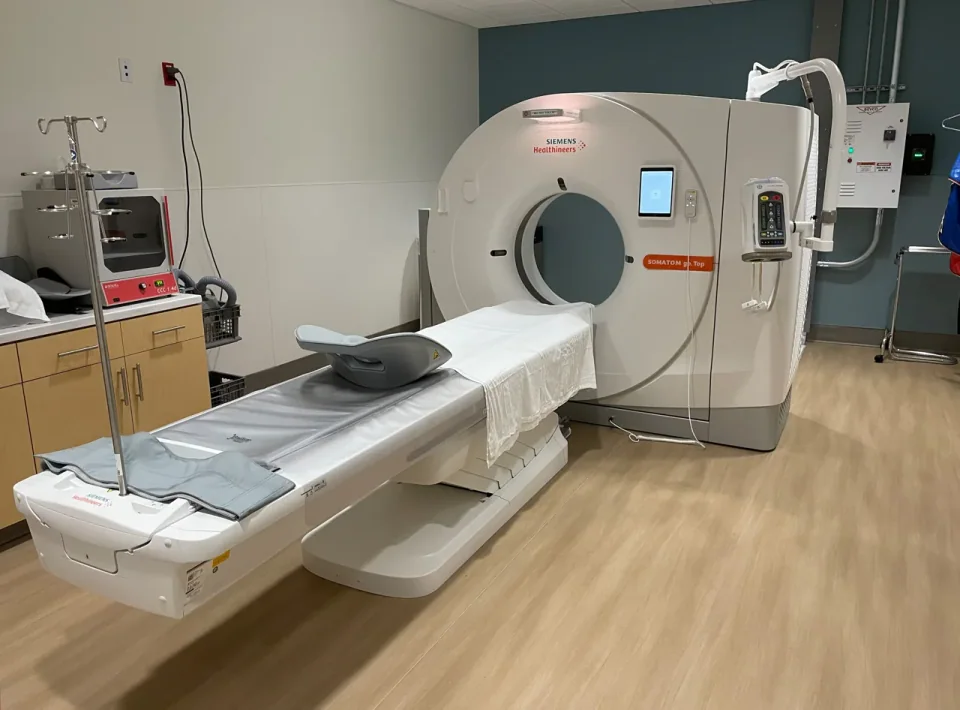
About this photograph
Not evidence of MMS stock, recommended options, current support, performance or endorsement.
The decision at a glance.
- Start here
- Specify the entire positioning-to-planning chain.
- Spend more when
- A documented fit, imaging or capacity limit needs the dedicated configuration.
- Watch the budget
- Include lasers, interfaces and physics resources.
- Check the support
- Accept the combined chain and its future change process.
Ask the supplier
- Does the actual immobilized setup fit and meet planning-image requirements?
- Who supplies and accepts the table, lasers and planning interface?
- Which advanced applications require additional commissioning resources?
Specify the treatment position before the scanner
The radiotherapy service needs images acquired in a position that can support its planning and treatment workflow. Start with the intended immobilization devices, patient range, positioning requirements and treatment-planning system. Have the responsible team define the complete chain before comparing scanners.
A large gantry opening is useful only if the actual patient and positioning assembly fit, the required anatomy can be imaged appropriately and the planning data can be accepted. Bring representative immobilization setups into the evaluation. A bare-table demonstration misses an important part of this purchase.
Bore and reconstructed field of view answer different questions
GE's Revolution RT page lists an 82 cm bore and an 80 cm extended field of view. The opening provides physical clearance; the reconstruction field describes an imaging capability. Neither number should be substituted for the other when judging whether the proposed setup can be used for planning.
Evaluate the required image and geometric performance in the intended positions, including any extended-field reconstruction. The product also offers motion-related and metal-artifact tools, but an attractive processed image does not establish the treatment-planning suitability of every protocol. The medical physicist must assess the configuration the service will use.
An overlay can be a route to evaluate, not a conversion certificate
GE's Service Shop lists a DIACOR flat tabletop for specified CT and PET/CT families. That makes an eligible existing scanner worth evaluating when its capabilities, schedule and support already suit the proposed work. It does not mean that any scanner with a flat accessory becomes a complete CT simulator.
Compare the whole adaptation: supported tabletop and immobilization interfaces, alignment equipment, necessary applications, planning export and physics commissioning. If another required component or service is missing, put its cost and responsibility into the same comparison. Keep accessory compatibility separate from acceptance of the entire clinical chain.
Check the laser scope before approving the room budget
The Revolution RT pre-installation manual explicitly states that CT simulation laser alignment systems are not supplied by GE HealthCare. Its room-layout illustration shows separate alignment equipment and controls. Treat those items as a named contract boundary rather than assuming the scanner order contains them.
Coordinate the actual mounting, control location and alignment requirements with the scanner and laser installation teams. The manual's illustration is a planning example, not an approved design for another building. Include installation and acceptance responsibilities as well as the accessory price.
New capabilities bring new commissioning work
AAPM published its TG-66U1 update in September 2026. The public abstract describes an expanded QA scope covering developments such as 4D CT, extended field of view, metal-artifact reduction and multienergy imaging. Buying these functions adds evaluation work; it does not remove the need to validate the planning chain.
Allocate qualified physics time, appropriate test resources, protocol development and end-to-end data checks before scheduling clinical use. Agree who will resolve an image-transfer or geometry problem spanning the scanner, workstation and planning system. A successful DICOM send is not the same as an accepted treatment-planning workflow.
Choose between adaptation and dedicated capacity
Adapting an eligible scanner can be economical when the accepted simulation scope is limited and scheduled access is dependable. A dedicated configuration earns its place when positioning, image capability, motion work or competing diagnostic demand creates a real limitation. Compare those limits before paying for every available application.
Include ongoing quality work and recommissioning after relevant changes in the ownership plan. The best-value route is the one that reliably supplies accepted planning data within the funded radiotherapy programme. Keep the decision open when the surrounding treatment service is not yet ready; the scanner cannot establish that service on its own.
Compare the options.
Dedicated RT configuration
- Capability
- Specified positioning and imaging tools.
- Best fit
- A real limitation justifies dedicated capability.
- Cost to watch
- Full room and planning integration.
Eligible adaptation
- Capability
- Existing scanner plus accepted additions.
- Best fit
- Capacity and technical scope are sufficient.
- Cost to watch
- Compatibility and commissioning.
External access
- Capability
- Accepted simulation pathway elsewhere.
- Best fit
- Local ownership is premature.
- Cost to watch
- Coordination and continuity.
Option notes, costs & support 3 options
Revolution RT, fully specified package
Dedicated simulation example
- Best for
- Accepted positioning, motion or capacity needs justify a dedicated route.
- Why consider it
- Purpose-built configuration with documented bore and imaging-field distinctions.
- The trade-off
- Lasers and planning integration need explicit scope.
- Price & package
- Complete room, positioning, software and commissioning.
- Support
- Assign responsibility across scanner, laser and planning suppliers.
Eligible CT with specified flat tabletop
Adaptation candidate
- Best for
- Existing capacity and capabilities can meet the accepted scope.
- Why consider it
- Makes use of an already supported imaging platform.
- The trade-off
- Accessory listing is not whole-chain approval.
- Price & package
- Overlay, alignment, applications and commissioning.
- Support
- Verify exact compatibility and future support.
Shared or external simulation access
Programme-stage alternative
- Best for
- A local dedicated chain is not yet sustainable.
- Why consider it
- Allows a complete accepted pathway to be compared with ownership.
- The trade-off
- Positioning consistency, data and scheduling need coordination.
- Price & package
- Whole simulation pathway and transport.
- Support
- Agree planning-data and interruption responsibilities.
Budget for the complete service.
CT simulation cost = accepted scanner/positioning chain + room and alignment works + planning integration + commissioning and continuing quality.
- Patient-position fit
- Imaging and motion capabilities
- Laser scope
- Planning interfaces
- Physics resources
Before you commit.
- Evaluate treatment-position setups.
- Separate bore from imaging field.
- Name accessory boundaries.
- Budget physics and end-to-end acceptance.
- Protect scheduled access.
Further checks & evidence limits
Questions to resolve
- Does the actual immobilized setup fit and meet planning-image requirements?
- Who supplies and accepts the table, lasers and planning interface?
- Which advanced applications require additional commissioning resources?
What the evidence does not establish
- No radiotherapy planning protocol or site-design approval.
- Only the 2026 AAPM report abstract was read; no numerical QA limits prescribed.
- No proof that an accessory-compatible scanner satisfies a particular simulation programme.
Sources & supporting evidence.
Manufacturer claims and seller offers are identified below. Prices apply to the stated offer and review date; confirm availability, configuration and delivered cost.
- Revolution RTGE HealthCare · manufacturer · checked October 18, 2026
Current written page distinguishes 82 cm bore from 80 cm extended field of view and lists motion/metal-artifact tools. No artifact-free, outcome or dose claim adopted.
- Revolution RT Pre-installation Manual 5938483-1EN revision2GE HealthCare · manufacturer · checked October 18, 2026
Selected room/laser text and diagram read. Section6.4 states CT simulation laser alignment systems are not supplied by GE HealthCare; actual contract scope still controls.
- DIACOR RTP flat tabletop, E6315JEGE HealthCare Service Shop / DIACOR · manufacturer · checked October 18, 2026
US accessory listing names specific CT/PET-CT families. Listing establishes a product identity, not universal compatibility or complete simulation readiness.
- AAPM TG-66U1 / Report 83.B updateAAPM / Medical Physics · professional-society · checked October 18, 2026
Published16September 2026. Abstract describes updated CT simulator QA scope including 4D CT, extended HU/field, metal-artifact reduction and multienergy; full report not read.
Put the guide to work.
Send MMS your equipment list, destination and budget. We can help you compare a complete package.
Discuss your equipment