
Cardiac CT: what does the cardiac package actually include?
Separate calcium scoring from coronary CTA, then compare acquisition, ECG equipment, reconstruction and the team needed to deliver the service.
Editorially reviewed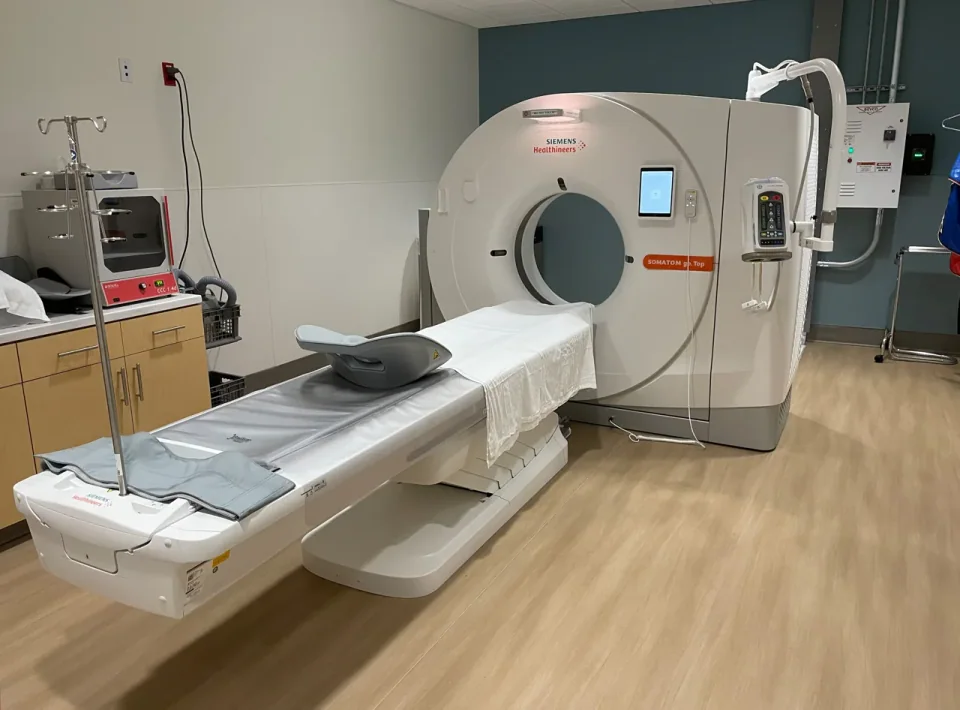
About this photograph
Not evidence of MMS stock, recommended options, current support, performance or endorsement.
The decision at a glance.
- Start here
- Define the actual cardiac programme before choosing hardware.
- Spend more when
- The clinical evaluation shows what extra capability changes.
- Watch the budget
- Include ECG, injection, analysis and specialist operation.
- Check the support
- Price every acquisition chain and application.
Ask the supplier
- Which cardiac examinations and patients define the brief?
- Which ECG, injector and analysis functions are included on the offered unit?
- What demonstrated limitation justifies the extra hardware and support cost?
Calcium scoring and coronary CTA are different briefs
Do not ask simply for a cardiac-capable scanner. State which examinations the service intends to offer and which it will refer. IAC's 2025 CT accreditation standards distinguish coronary calcium scoring from coronary CTA, with different equipment and processing requirements. Its accreditation minimums are not a guarantee that a particular purchase will suit every local patient.
Have the responsible clinical team define the intended population and acceptable examination performance before selecting hardware. Keep preparation, contrast administration, monitoring, emergency response and reporting within the approved service plan. An equipment guide cannot replace that clinical programme.
Rotation time and temporal resolution are not the same number
Two Siemens examples illustrate what extra hardware can change. go.Top advertises an ECG-synchronized cardiac application and optional 0.33-second rotation. The manufacturer's historical Force white paper describes a dual-source arrangement with two tubes and detectors, quoting 66 ms temporal resolution at 0.25-second rotation.
Do not compare rotation time on one offer with temporal resolution on another as though they were the same specification. Ask how the quoted cardiac acquisition works on the offered hardware, software and acquisition mode. The figures identify different architectures; they do not prove a diagnostic winner or authorize a particular patient selection.
Price the cardiac package from acquisition through reporting
The purchase schedule should identify the ECG equipment and synchronization capability, injector, cardiac reconstruction, analysis workstation, enabled applications and reporting route. IAC's framework includes task-specific reconstruction capabilities and recommends including ancillary equipment in maintenance planning. A scanner that acquires the data is only part of the chain.
For a used machine, demonstrate the required application on its actual software version. Record which functions run at the console, which require another workstation and which have a recurring or transferable licence. A demonstration performed on the seller's separate workstation does not establish what will arrive at the hospital.
Use representative work to justify the premium
Ask the clinical and physics teams to define an evaluation that reflects the planned service, including the cases the lower-cost candidate may struggle to serve. Review usable examinations, repeat work, interpretation needs and the resulting patient pathway. A selected vendor case collection cannot establish performance across that population.
A premium can be worthwhile when a documented limitation affects enough of the intended work. It is harder to justify when the service has little cardiac demand or must still refer most proposed cases for other reasons. Preserve the option of routine CT locally with specialist cardiac access elsewhere.
More hardware changes the support conversation
A dual-source offer contains two acquisition chains to account for. Request explicit tube, generator, detector and calibration coverage rather than assuming an ordinary CT contract has the same boundary. This is a difference in support scope, not evidence that the system will fail more often.
Compare full ownership over the same period, including cardiac software, ECG and injector support, quality work and interruption provision. A lower annual service fee with major exclusions can reverse the apparent purchase-price advantage. Check current regional eligibility for the exact unit rather than relying on a historical product paper.
A smaller programme can still be a better service
A hospital does not need every cardiac application to make a useful, sustainable contribution. A clearly bounded service with qualified reporting and reliable onward referral may be better value than a broad advertised capability that cannot be staffed.
Keep an accepted existing system when it meets that brief and remains supportable. Upgrade when the clinical evaluation shows what extra capability buys and the budget funds the whole pathway. The decision should survive removal of the impressive slice number from the quotation.
Compare the options.
Configured single-source
- Capability
- Accepted cardiac options.
- Best fit
- Evaluation supports intended work.
- Cost to watch
- Complete ECG and processing chain.
Configured dual-source
- Capability
- Different acquisition architecture.
- Best fit
- A demonstrated limitation justifies the premium.
- Cost to watch
- Hardware and support scope.
External specialist access
- Capability
- Defined referral pathway.
- Best fit
- Local specialist service is not sustainable.
- Cost to watch
- Travel and continuity.
Option notes, costs & support 3 options
go.Top with specified cardiac options
Single-source example
- Best for
- An accepted programme matched to the exact configuration.
- Why consider it
- Shows cardiac capability depends on selected options.
- The trade-off
- Family demonstrations do not prove installed licences.
- Price & package
- Scanner, ECG, injector and processing package.
- Support
- Verify all cardiac accessories and software.
SOMATOM Force, exact generation and software
Dual-source example
- Best for
- A clinical evaluation justifies the acquisition architecture.
- Why consider it
- Two source/detector chains offer a distinct temporal-resolution approach.
- The trade-off
- Historical architecture evidence is not current support proof.
- Price & package
- Two-chain service scope and complete applications.
- Support
- Obtain exact unit and regional eligibility evidence.
Routine CT plus specialist cardiac access
Bound the local service
- Best for
- Specialist volume or staffing does not justify expansion.
- Why consider it
- Preserves useful local imaging without an incomplete cardiac programme.
- The trade-off
- Referral and records transfer must work.
- Price & package
- Whole patient pathway.
- Support
- Agree access during local or referral interruptions.
Budget for the complete service.
Cardiac CT ownership adds the required acquisition options, processing, specialist team and quality programme to the complete CT cost.
- Accepted case mix
- Acquisition architecture
- ECG and injector
- Analysis licences
- Subsystem support
Before you commit.
- Separate calcium and coronary CTA scope.
- Compare like-for-like temporal specifications.
- Demonstrate installed applications.
- Budget specialist staffing and quality.
- Name service exclusions.
Further checks & evidence limits
Questions to resolve
- Which cardiac examinations and patients define the brief?
- Which ECG, injector and analysis functions are included on the offered unit?
- What demonstrated limitation justifies the extra hardware and support cost?
What the evidence does not establish
- No clinical protocol, medication, patient-selection or universal minimum specification recommendation.
- No head-to-head outcome, reliability or price ranking.
- Force white paper is historical international architecture evidence.
Sources & supporting evidence.
Manufacturer claims and seller offers are identified below. Prices apply to the stated offer and review date; confirm availability, configuration and delivered cost.
- IAC Standards and Guidelines for CT Accreditation, April 2025Intersocietal Accreditation Commission · accreditation-body · checked October 18, 2026
Relevant instrumentation, processing, safety-policy and acceptance sections read. IAC accreditation framework, not a universal purchasing rule.
- SOMATOM go.TopSiemens Healthineers · manufacturer · checked October 18, 2026
Current product page gives an ECG-synchronized cardiac example and optional 0.33-second rotation; actual supplied package remains configuration-specific.
- SOMATOM Force: Get two steps ahead with Dual Source CTSiemens Healthineers · manufacturer · checked October 18, 2026
Historical international manufacturer white paper: two X-ray sources/detectors and stated 66 ms temporal resolution at 0.25-second rotation. Architecture evidence, not current eligibility or comparative clinical proof.
Put the guide to work.
Send MMS your equipment list, destination and budget. We can help you compare a complete package.
Discuss your equipment