
Breast ultrasound: make the probe package earn the upgrade
Compare the required imaging, reporting and approved procedure setup before paying for elastography or AI. Exact probes and enabled options matter more than a premium model badge.
Editorially reviewed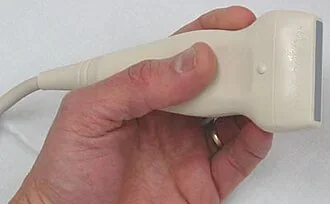
About this photograph
Not evidence of MMS stock, recommended options, current support, performance or endorsement.
The decision at a glance.
- Start here
- Have the breast-imaging team define required tasks, then compare exact probe, software, reporting and procedure-accessory packages.
- Spend more when
- The additional function or dedicated capacity closes a demonstrated requirement rather than adding an unneeded feature.
- Watch the budget
- Breast-ultrasound ownership cost = accepted scanner/probes/options + reporting and procedure setup + supplies, probe care, maintenance and continuity over the same period.
- Check the support
- Optional-feature marketing substitutes for current availability, approved accessory compatibility or a complete accepted package.
Ask the supplier
- Which exact probe, release and optional functions are included and available in our region?
- Which approved procedure accessories and ongoing supplies are included?
- Can the package complete our required imaging, documentation and reporting workflow?
Choose the service before the feature list
An established breast-imaging team should define what the ultrasound package must do: required diagnostic imaging, documentation and any planned image-guided work. Keep this equipment decision distinct from the wider screening or mammography pathway. The buyer’s job is to fund the agreed service, not infer a clinical protocol from a product brochure.
Separate essential functions from desirable additions. If the current accepted system completes the required work but its probe needs replacement, compare that repair or replacement first. A new console earns its place when it closes a defined imaging, workflow, access or support gap that a smaller investment cannot solve.
Compare exact probe and platform combinations
Philips illustrates breast imaging with EPIQ Elite and eL18-4. Its eL18-4 specification page lists breast use and identifies biopsy and image-fusion navigation capability. These are useful configuration leads, but “capable” does not mean the offered package includes every required accessory or software option.
GE’s LOGIQ E10 materials show breast imaging and 2D shear-wave examples with ML4-20-D. That gives a second named combination to investigate. Neither manufacturer’s selected images establish a head-to-head winner, and a quote for an EPIQ Elite or LOGIQ E10 without the exact probe and enabled functions is not yet a comparable offer.
Make elastography and AI separate buying decisions
An advanced tool should have a named purpose in the clinical brief and an agreed way to evaluate it. Establish which function is required, where it runs, whether its licence transfers, and whether additional reporting or workstation software is needed. Otherwise an attractive option can consume money needed for the everyday probe, service or staffing.
Check regional availability and the exact software release rather than assuming that everything on a manufacturer’s application page is available on the offered machine. Philips’ breast page carries an availability limitation, so a buyer should obtain clear product-specific evidence for any proposed AI feature. Do not price an advertised future capability as an included present benefit.
A biopsy-capable probe is not a complete procedure package
For planned image-guided work, have qualified staff identify the approved probe/accessory combination and the required supplies and processing route. Reconcile the bracket, guide or other necessary components against the offer. A generic biopsy-capable field cannot establish that a particular accessory fits or that it is included.
Evaluate handling and the actual clinical workflow through the team’s approved acceptance process. Account for preparation, inspection, cleaning, storage and availability between cases. A second accepted probe may solve an availability problem more directly than another imaging option; its ongoing care and support still belong in the comparison.
Follow the examination into the record
Demonstrate the required labels, annotations, measurements, saved images and report using the offered configuration. Establish what transfers into the receiving system and what must be entered again. A good image shown at the console is only one part of a complete diagnostic workflow.
Finally compare probe repair or replacement, temporary cover and the limits of the actual warranty. Do not turn a reseller’s broad warranty promise into assumed coverage for every transducer or destination. The better purchase is the accepted package that meets the service’s requirements at a supportable total cost, with optional functions priced for the value they actually add.
Compare the options.
EPIQ Elite with a verified eL18-4 package
- Capability
- Manufacturer materials identify the pairing and relevant probe capabilities.
- Best fit
- A breast service evaluating the documented probe and required options.
- Cost to watch
- Confirm exact software, accessories and regional feature availability.
LOGIQ E10 with a verified ML4-20-D package
- Capability
- Manufacturer examples identify breast and shear-wave imaging with this probe.
- Best fit
- A service comparing an accepted alternative with defined imaging requirements.
- Cost to watch
- Illustrations do not establish all-unit inclusion or comparative clinical performance.
Repair or complete the accepted installed system
- Capability
- May preserve useful training, reporting and accessories.
- Best fit
- Adequate capability with a resolvable probe, access or workflow gap.
- Cost to watch
- Support and the condition of the exact equipment remain decisive.
Option notes, costs & support 3 options
For every option
- Price & package
- Compare the complete configured package; no current matched price established.
- Support
- Confirm exact release, probe condition and destination repair eligibility.
EPIQ Elite with a verified eL18-4 package
Named configuration lead
- Best for
- A breast service evaluating the documented probe and required options.
- Why consider it
- Manufacturer materials identify the pairing and relevant probe capabilities.
- The trade-off
- Confirm exact software, accessories and regional feature availability.
LOGIQ E10 with a verified ML4-20-D package
Named configuration lead
- Best for
- A service comparing an accepted alternative with defined imaging requirements.
- Why consider it
- Manufacturer examples identify breast and shear-wave imaging with this probe.
- The trade-off
- Illustrations do not establish all-unit inclusion or comparative clinical performance.
Repair or complete the accepted installed system
Smaller-investment comparison
- Best for
- Adequate capability with a resolvable probe, access or workflow gap.
- Why consider it
- May preserve useful training, reporting and accessories.
- The trade-off
- Support and the condition of the exact equipment remain decisive.
Budget for the complete service.
Breast-ultrasound ownership cost = accepted scanner/probes/options + reporting and procedure setup + supplies, probe care, maintenance and continuity over the same period.
- Exact breast-imaging probe
- Required versus optional functions
- Approved procedure accessories
- Reporting and image documentation
- Probe availability and service
Further checks & evidence limits
Questions to resolve
- Which exact probe, release and optional functions are included and available in our region?
- Which approved procedure accessories and ongoing supplies are included?
- Can the package complete our required imaging, documentation and reporting workflow?
What the evidence does not establish
- Clinical requirements and acceptance need qualified breast-imaging review; this is not a screening or procedure protocol.
- Philips availability-footnote scope requires exact feature/region confirmation; no blanket AI authorization asserted.
- No matched current price, all-unit warranty or independent performance/reliability ranking established.
Sources & supporting evidence.
Manufacturer claims and seller offers are identified below. Prices apply to the stated offer and review date; confirm availability, configuration and delivered cost.
- Breast ultrasound: manufacturer application overviewPhilips · manufacturer · checked October 18, 2026
Complete written application overview read: EPIQ Elite/eL18-4 examples, strain/shear-wave, needle visualization and microflow. Page contains an availability footnote reading 510(k) pending/not available in USA whose exact feature scope is not sufficiently clear to infer blanket availability. No clinical superiority or biopsy-outcome claim adopted.
- eL18-4 transducer product specificationsPhilips · manufacturer · checked October 18, 2026
Product specification table read: linear transducer, breast application, biopsy-capable and image-fusion-navigation-capable fields. Capability does not identify included brackets, guides, tracking hardware or licences. No frequency inferred from the probe name.
- LOGIQ E10 clinical images, August 2024GE HealthCare · manufacturer · checked October 18, 2026
Published examples identify L2-9-D for carotid PW waveform and ML4-20-D for breast/shear-wave imaging. Demonstrated manufacturer examples are not inclusions of every unit or comparative performance evidence.
- LOGIQ E10 Series product pageGE HealthCare · manufacturer · checked October 18, 2026
Current public examples include ML4-20-D breast 2D shear-wave and L2-9-D lower-extremity venous micro B-Flow. Specific offered release, licences and probe condition remain purchase checks.
- Ultrasound care and cleaning, including TEE guidancePhilips · manufacturer · checked October 18, 2026
Public written inspection, compatible-product and TEE care overview read. Video and all linked model IFUs were not reviewed; no processing instructions reproduced.
Put the guide to work.
Send MMS your equipment list, destination and budget. We can help you compare a complete package.
Discuss your equipment